Tool Box

Why Dracula Should Make It Onto Your AP Reading List

My favorite book to teach is always the one that I’m doing with my students at the moment. Occasionally I’ll be waiting for the elevator next to a teacher from the math or careers department who will make an innocent attempt at small talk ask me which novel I like best, and I invest way too much emotional energy explain that I could never pick.

Except… Dracula is kind of my favorite. (Don’t tell Homer.) I have a real, formerly-live bat frozen in resin that I share with my students:

I bought this Edward Gorey Dracula paper doll theater for my students, but actually it was for me:

Edward Gorey's Dracula: A Toy Theatre

Teaching this novel is always a highlight of the year for me, and I’d like to make a case that you should consider bringing it to your classroom as well:

  1. It’s about society’s fear of infectious disease. It’s about other things too, but the infection metaphor is a pretty strong thread. English society was coming to grips with the consequences of urbanization and post-colonial immigration, and tuberculosis was among those. Bram Stoker himself suffered from syphilis making swiss cheese of his brain. In a year when we want to guide students through the complex feelings that many of them are having about current events without overwhelming them, coming at the pandemic from an oblique angle might be the right strategy.
  2. It’s the most fun a kid can have with Victorian-era syntax and diction. Compound-complex sentences with modifiers of all types abound, but — vampires! You get to blow the dust off of words like “badinage” and “vulpine.” It’s almost-painless preparation for close reading of pre-20th century texts.
  3. You couldn’t find a better tool for teaching inference. The novel is epistolary in form, so student-readers take on the role of detective as they piece together the mystery through letters, journals, telegrams, and documents. Stoker uses dramatic irony to full effect so that the horror of Dracula’s dastardly plan is revealed to the reader far earlier than it is to the characters.
  4. It offers a bite-sized introduction to critical theory; there are delicious possibilities in reading it through a Freudian, feminist, Marxist, or post-colonial lens. You could also make the case (and many of my students do) that the novel (as well as the recent BBC/Netflix adaptation) makes a strong Christian argument, and so that very flexibility of interpretation would make a case for reader-response!
  5. The vampire folklore on which it is based invites some meta-reflection on how and why we tell stories. The mythology arose in Central and Eastern Europe out of a need to explain (you guessed it) epidemics of disease. The lesson on how we invent monsters to make sense of the things that scare us or that we don’t understand is one that applies to both other works of literature (Frankenstein, anyone?) but also the rhetoric and media of the 21st century.
  6. There are so many rich opportunities for film analysis — tracing the evolution of Dracula’s depiction from the grotesque Count Orlok in Nosferatu (1922) to Jonathan Rhys Meyers’s seductive incarnation in the 2013 TV series, considering Werner Herzog’s singular aesthetic in the ‘70s Nosferatu reboot, appreciating Bela Lugosi’s masterful performance in the 1931 Universal film that would define the character in the popular consciousness, analyzing the humor of parody in What We Do in the Shadows (2014).
  7. It’s in the public domain, which in the world of virtual teaching makes life just a little simpler. It’s also so easy to pull just excerpts or make an abridged version for your students based on your particular objectives.
  8. Good triumphs over evil. In 2021, we need stories that give us hope, and while there’s lots to be gleaned from Shakespearean tragedies and postmodern meditations on the meaning (or meaninglessness) of life, maybe right now an unambiguous happy ending, at least in the stories that we consume.

If you’re ready to sink your teeth into this juicy novel, join us a community of teachers over on our Facebook group to share ideas and resources!

Tool Box

Five Ways to Use Maps in the ELA Classroom

In the middle of last year, it looked as though I would finally realize my dream teaching assignment: an integrated English and world geography course for ninth graders. I was so excited to be able to teach about the settings of the literature we read in an interdisciplinary way. No longer would I navigate the border between text and context! The world was literally mine.

Like all plans born in 2020, this one wasn’t to be, at least not now. In July a septuagenarian colleague decided neither the prospect of returning face-to-face nor of teaching virtually was something that she was up for, so I picked up her sections of seniors.

But I was spending my quarantine summer taking National Geographic’s free “Mapping as a Visualization and Communication Tool in Your Classroom Course,” and I wanted to still find some ways to put those new understandings to use.

So here it is, how I’m teaching-geography-without-teaching-geography, five ways that English teachers can sneak maps into their curricula:

1. Take inventory of your reading list.

Maps help us to mentally process data, and one immediate application is in developing a picture of the literature that we teach. I created this map using the “my maps” feature of Google Maps to audit who and what I was teaching. I was able to layer authors’ origins, authors’ genders, and the settings of the books we read as part of my ninth-grade curriculum:

When you look at information in this way, patterns emerge. The literature that I teach seems to be largely Western. Other regions of the world are represented, but often by a single text. The map by itself isn’t an argument or evaluation, but this visualization helps me to ask some questions about what and how I’m teaching. Are there works in translation that I’m missing out on? Are the depictions of non-Western people in the literature we read authentic?

Here’s how to do this yourself:

2. Support students in reading comprehension.

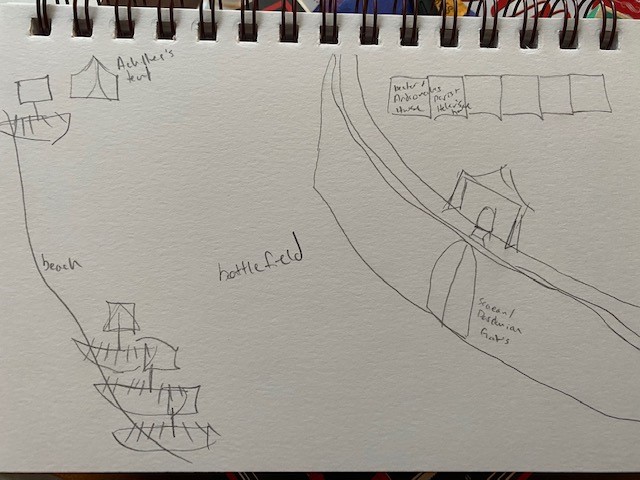
In my new senior-level English class, we started the year reading Homer’s Iliad, the classic story of the Trojan War. Something like ¾ of the way through the epic poem, I realized that students were having trouble tracking the action of the plot because they didn’t have a visual understanding of the features of the physical environment. How was it significant that Helen and Priam are having a conversation on top of the city walls? Why was it such a big deal that the Trojan forces fought their way to the Myrmidon encampment of the Greek forces?

My own poor sketch of the important locations in the Iliad — it’s the process and not the product! 😉

Last year I had students track the characters’ movement across Western Europe in The Count of Monte Cristo, and I know that experience helped them to understand an intricate plot based on deception and subterfuge.

I made a large map using our library’s mega-printer and then laminated it so that different groups of students could use whiteboard markers to label the map and then erase.

So this year, if I had taken some time to sketch out – or have students sketch out – the world we were working with, the characters’ choices would have made much more sense to them. Oh well – now I know better for next year!

3. Explore setting and context.

My ninth-grade students also start the year with Greek mythology in the form of Homer’s Odyssey. I love to show them maps of Odysseus’s journey – even though he wasn’t a real character (as far as we know!), we can trace the origins of some of the myths to different actual locations.

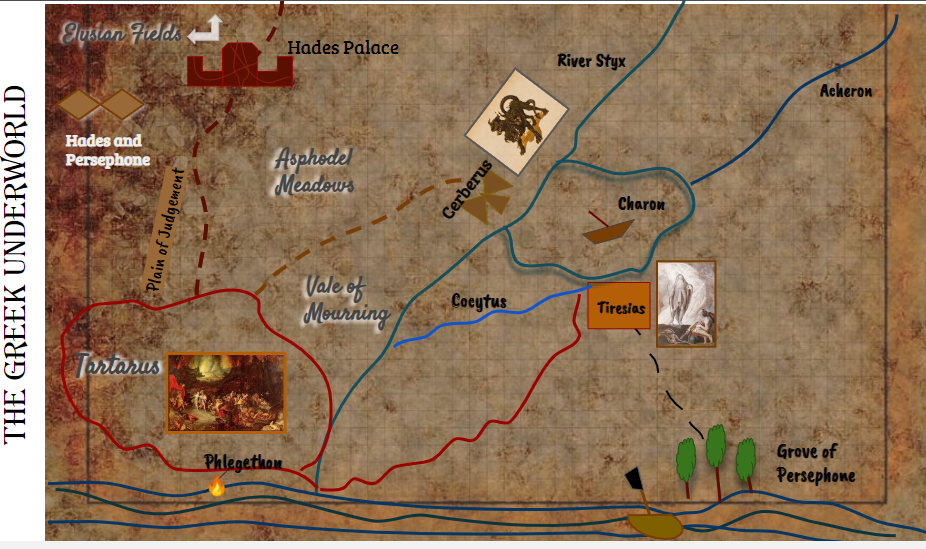
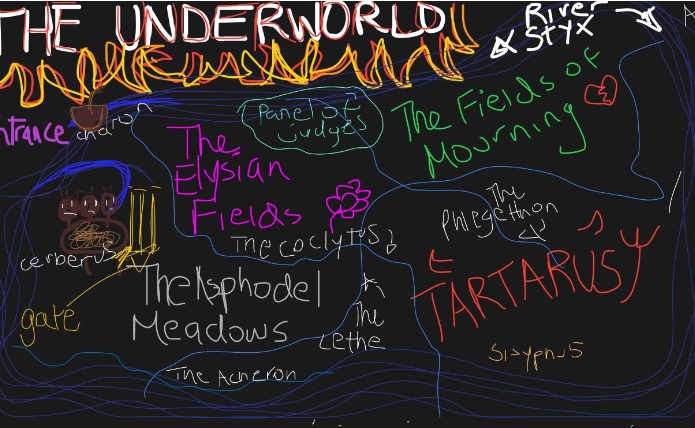
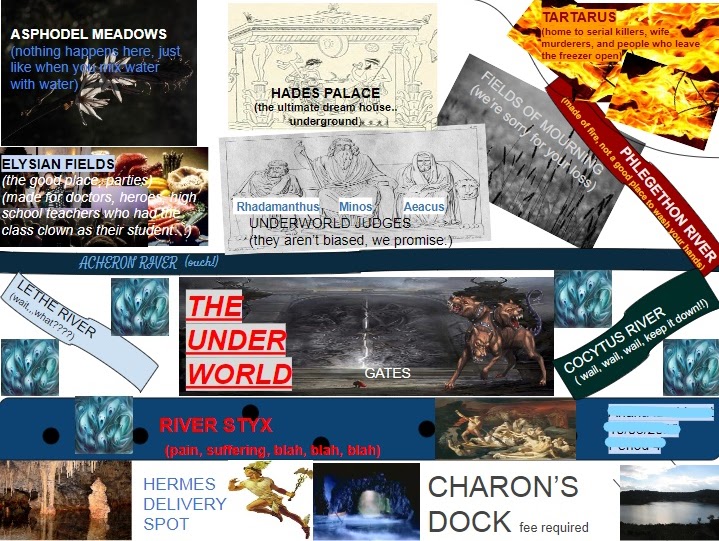
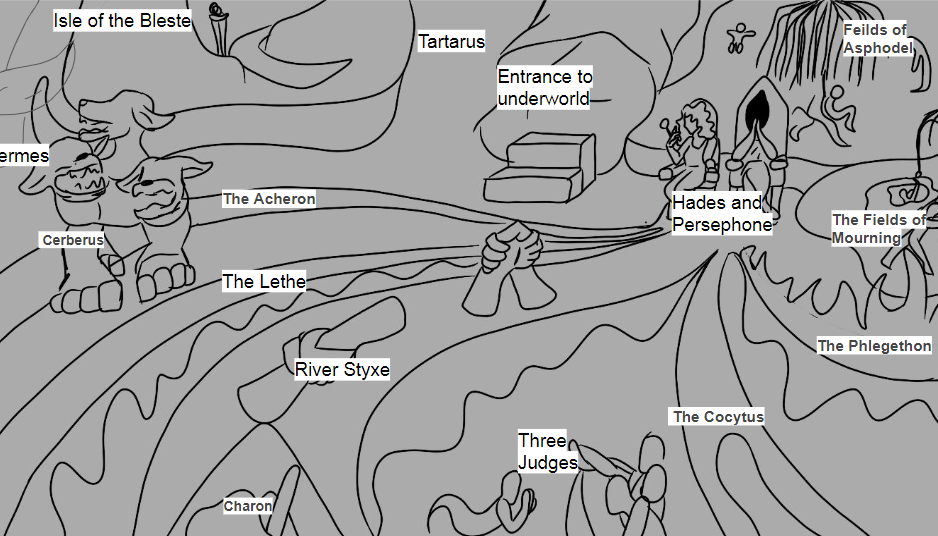
But this year, I also asked my students to create maps of their own for a different facet of the mythology: Odysseus’s descent to the Underworld. In Book 11, Odysseus must travel to Hades to consult with the ghost of a prophet about how to return to his home. The world of the Greek afterlife was a rich setting, and the different physical features and boundaries help us to understand the mood of the text. Below are some of my favorites, but check out some of the others!

4. Consider perspective, bias, and argument in visual texts.

Maps can not only help us to understand texts but can also be texts themselves. The same questions that we ask about other artifacts – speeches, political cartoons, advertisements – are equally valid when considering how mapmakers choose to represent physical space.

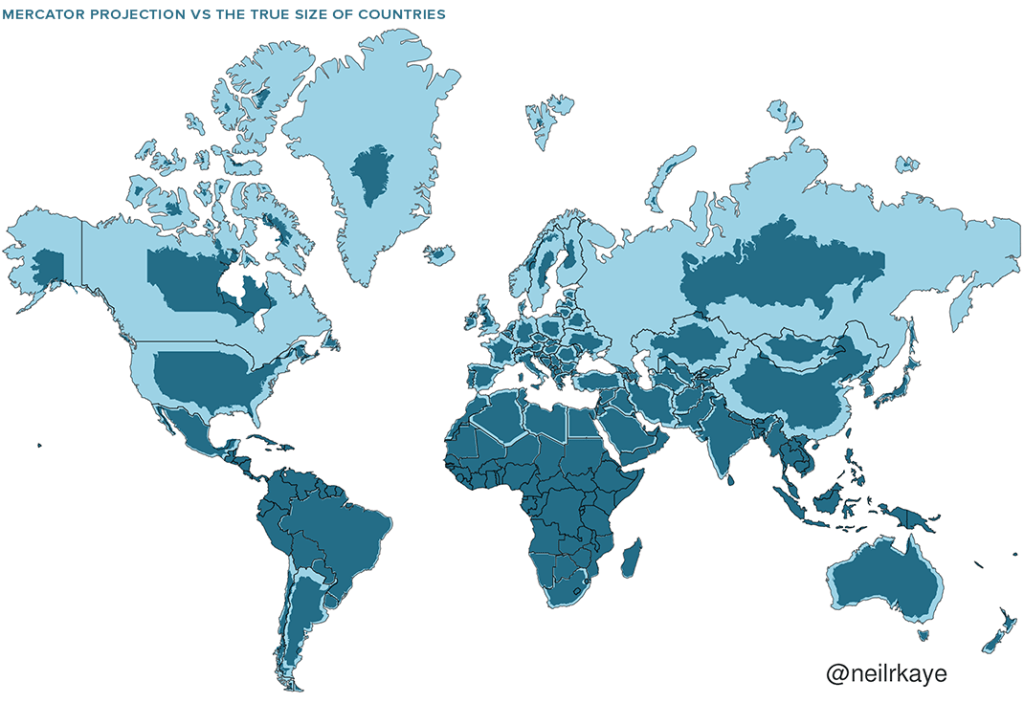
Consider the Mercator Projection’s racist origins and effect. Or take a look at the here-be-dragons maps of centuries past warning people not to veer too far away from the familiar.

This map by @neilrkaye demonstrates how countries in the Northern Hemisphere are depicted as much larger than their actual size by the Mercator projection.

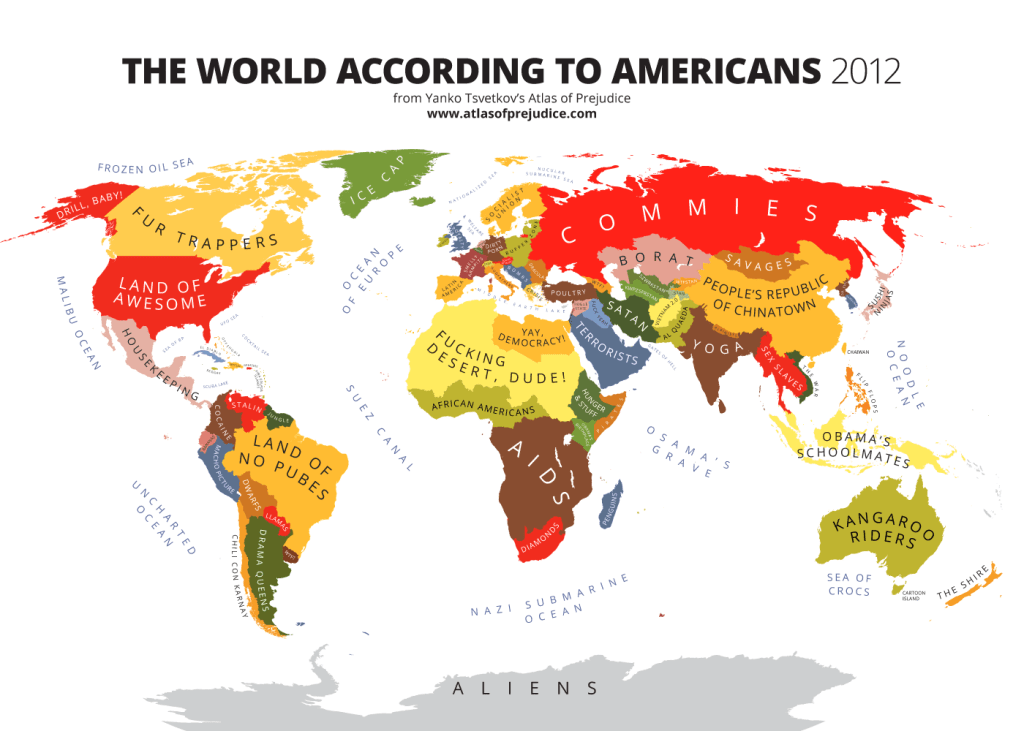
This article from National Geographic – “Why your mental map of the world is (probably) wrong” – invites teachers and students to check the ways in which our understanding of reality might be inconsistent with the truth and meditate on how we might have come by that false knowledge. And the Atlas of Prejudice – which I certainly wouldn’t use with younger students – would make a nice “body of work” for IB Language and Literature students or an element of the synthesis question for AP Language.

5. Visualize plot through metaphorical maps.

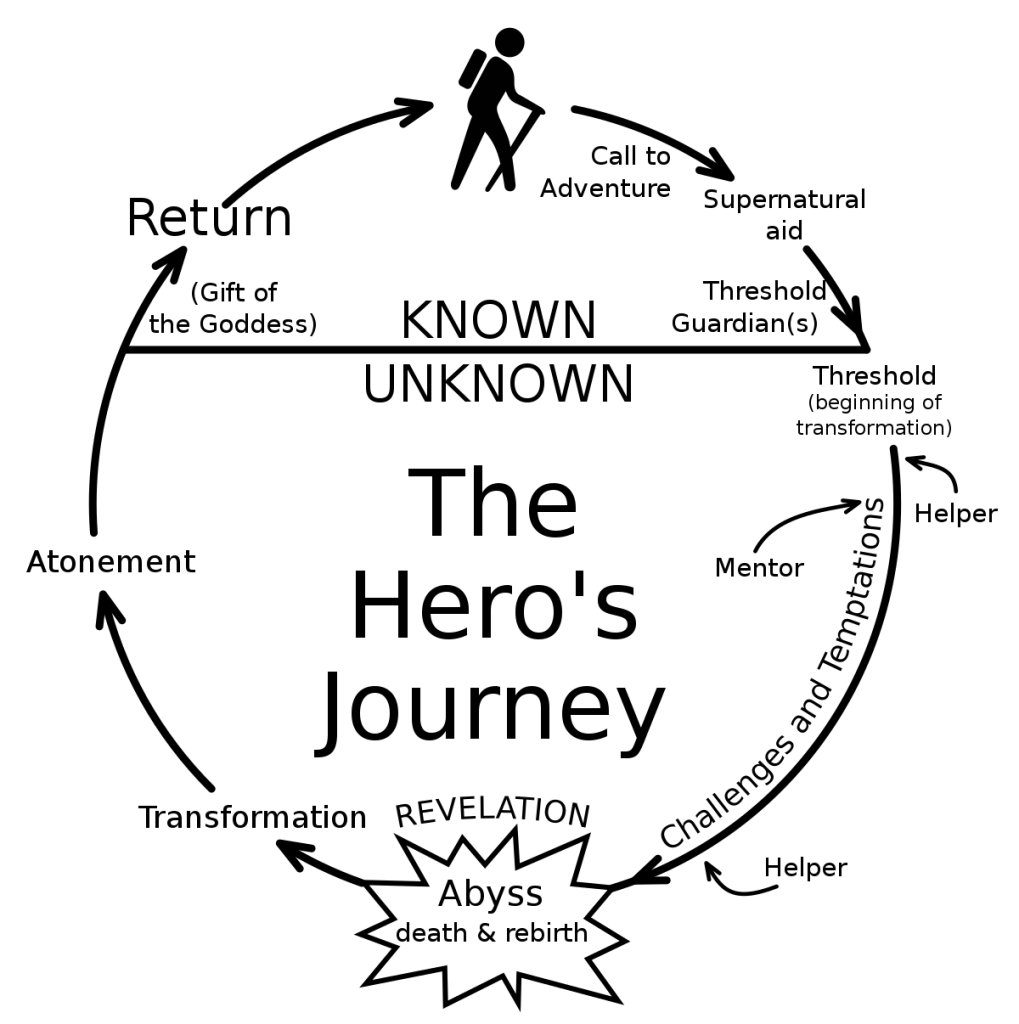
Finally, ELA teachers, I bet you’ve actually been using maps all along. If you’ve ever taught Campbell’s monomyth/the hero’s journey or Freytag’s triangle for plot, you’ve been using maps. Granted, this are models that demonstrate a character’s movement through metaphorical or emotional space, but that movement is often layered alongside a physical journey.

That’s it! Maybe there is a secret geography teacher in you too!

Soap Box

The 2% Principle

I went to college at a very large state university known for its conservative politics, its fanaticism about football, its ties to the military, and its love of tradition. So I fit right in (not).

I heard that the term for a person like me — someone who chose not to invest in the campus life beyond academics — was a “two-percenter” (owing, I guess, to the proportion of the student body that we made up).

Le lait, c’est moi.

Because I had earned lots of college credit in high school, it only took me three semesters to graduate, but that time felt interminable, and it was one of the loneliest periods of my life. I still feel wistful when other people reminisce about their college years, but it’s made me appreciate what a blessing it is to be able to be a part of a community where I do feel that I belong.

Everything that was missing from my college experience is a part of my daily life at the high school where I have now taught for eight years: values that I share, a sense of purpose, a community of supportive peers. When I get to campus each day, I don’t feel as though I’m just putting in my time — instead I’m investing in a group of people whom I care about.

I’ve come to think of one of the ways in which I try to do this as my “two percent principle.” There are almost 4,000 people in our school, each faced with their own individual and systemic challenges. I want to be a positive force in those lives, but I know there’s no way that I can create enormous, significant changes in all of the complicated dynamics of our social system every single day.

So instead, I look for ways to make people’s days two percent better. These are tiny, quick actions that don’t take a lot of planning. They can be spontaneous, they have to be intentional, and they’re usually things that fall outside of a strict understanding of one’s official job responsibilities.

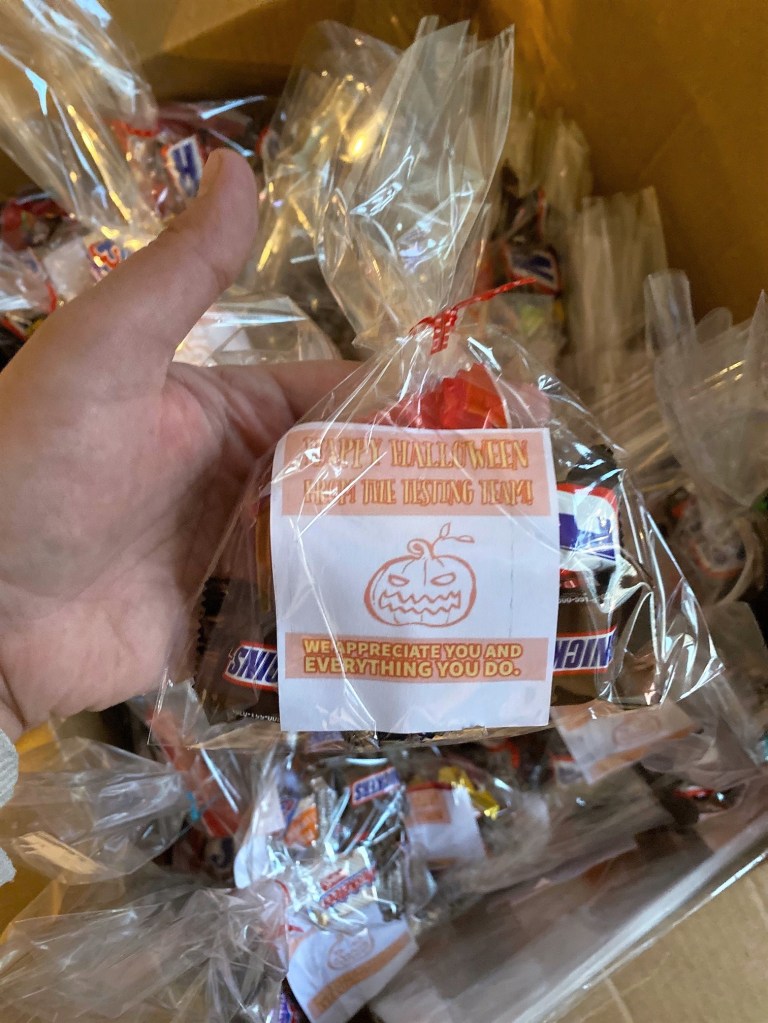
For example, this week we’re giving the SAT and the PSAT. Proctoring a standardized test is a shitty, miserable gig at the best of times; a life-threatening pandemic hasn’t done anything to improve the experience. So last night I watched the new version of Emma on HBO and packaged up 125 tiny bags of Halloween candy to put inside the testing boxes along with the bubble sheets and materials control forms and seating chart and testing script and so on.

No teacher is going to experience a peripeteia in their narrative arc as a result of getting a bag of cheap chocolates. But maybe the loss of instructional time, potential for exposure to a deadly disease, mind-numbing tedium, and sense of despair at the absurdity of the standardized testing industry will suck less (maybe two percent less) with some token sweets and a note saying “I see you.”

When I think about what makes my days two percent better, it’s often in the moments that others take to connect with me. As I’m winding down for the evening, it’s such a pleasure to be able to linger over the minutes in which someone took to check in on me or share a confidence or point out a win that I had. I love how my district’s new chat application makes this possible for me to do with my students:

Framing the difference that I hope to make in terms of the accumulation of lots of little two-percent interactions over all of my days is something that is helping me to feel like I have some control and influence in this awful year. And I can’t help but feel like if just five or ten people had tried to make a two-percent difference in my life when I was a student in college, my entire experience there might have been a good one.

Soap Box

Back-to-Basics

You know the feeling you get when you wake up in a hotel room and for the first few seconds of consciousness, you’re very confused about where you are?

That’s been every day of 2020 since March. I don’t use an alarm clock anymore because my baby is the alarm clock, and for those first bleary-eyed moments in the dark as I’m coming up from my dreams, I’ve forgotten when we are until it comes rushing back to me – the pandemic, the isolation, the anxiety, the 57 precautions I now need to take going about my day.

Just one of the ways in which my world has been totally upended was in our shift to virtual learning. I have been in a physical school continuously, in some capacity, for the past three decades.

And yet, changing the form of school in such a fundamental way has been, for me, a largely positive experience. Now that I have the urgency to make them work, I’m delighted and amazed by all of the possibilities offered by the myriad tech tools. Because of our new time constraints, I’m rethinking virtually everything about my role and my work in the classroom.

At the same time, I’m still craving the familiarity and the comfort of life-before-COVID. And upon reflection at the end of our first grading cycle, I think my students are too.

So instead of a list of new ideas, approaches, pieces of technology, etc., here are a few traditional school practices that I have found that have continued to be valuable:

  1. Calling roll. Do I need to call roll? I do not. I can download a list of everybody who attended our live session in a matter of seconds. It’s time-consuming (taking up 10 of my precious 50 minutes every-other-day) and has no instructional value. But given the universal difficulty of getting students to participate via virtual platforms, I’ve found that there’s a payoff to reminding students at the start of class that they do have a microphone and that it does work. Furthermore (and I can’t take credit for this idea – someone in my PLN came up with it), I’ve been using it as an excuse to ask students to share something that gives me a sense of who they are instead of just saying “here.” Someone suggested asking students to share a piece of good news; I’ve also had luck with asking them to tell me something they’re grateful for or something they’re excited about as well as using one of those silly which-one-are-you? memes.
  2. Reading out loud. I didn’t even do this prior to The Great Disaster That Is 2020. We didn’t have time. I needed to teach grammar, various genres of writing, vocabulary, test-taking strategies as well as have options for creative expression, incorporate opportunities for group work, build students’ social and emotional skills, form trusting and safe relationships with each individual kid, and oh yeah, actually discuss the literature. But I knew that if it was a struggle to get my students to read at home in 2019, it sure-the-heck would be now. So even though my instructional time has been cut in half, I made similar cuts to my texts, and now a chunk of each day is story time. But this necessity has turned out to be a surprise win because it’s forcing my students to slow down and be present. We’re using “my” time and not “theirs,” so there’s no reason to rush. And I can tell from their responses that they’re catching more than they usually do when reading is primarily silent and independent. I’ve recently started to break the dialogue into roles and ask them to help me while I do the “narration,” and that makes it even more engaging.
  3. Presentations. Like teachers everywhere, I have been pulling my hair out over how quiet and unresponsive my students were at the beginning of the year. They weren’t responding to my questions, they weren’t reacting to my jokes. But once I ceded the floor in its entirety by telling them that they needed to share something of value with the rest of the class, they started to shine. I think this works for a number of reasons: 1) they get time to prepare exactly what they want to say instead of being put on-the-spot, 2) they get to work with others (and practice talking through their topic in a small, trusted group before doing it in front of everyone), 3) by making it a “grade” (because everyone’s getting a 100, even though I don’t tell them that), it gives them the excuse to try.
  4. Right-and-wrong answers. This one is kind of a cheat because I’ve primarily doing this through EdPuzzle. I find or create videos that cover some of the content I need students to know, and then I splice in dead-easy multiple choice questions with only two answers (one of which is usually very obviously incorrect). When I asked my students what has been working well for them this year, this is what they’re most enthusiastic about. Why? My hypothesis is because we all need opportunities to do some lower-level thinking (and feel successful and productive in it). Just like grading technology-rich, multi-faceted product of a student’s original design can be both rewarding and exhausting for teachers, creating work like that take a lot out of our students, and doing that everyday, in all your classes, during the apocalypse is too much.
  5. Lecture. I said it. I’ve said it before. I’ll say it again. Lectures have a place in teaching and learning. Not the only place, not the most important place, but they deserve to be a tool in any skilled educator’s repertoire. But why is lecture a particularly effective strategy in this moment? Because while I think it is always satisfying to have an expert in a particular discipline guide you in an organized and systematic way through an unfamiliar body of knowledge, 2020 is particularly lacking in such encounters with credible authority. An anarchical free-for-all with regard to knowledge is part of what got us into this mess (in terms of the notion that all opinions on science and epidemiology and public health policy are equally valid). I can’t tell my students that everything is going to be okay or that they need to follow this set of steps to stay healthy or that democracy as-we-know-it will continue to exist post-November, but I can tell them about how Ancient Greek ideas about the underworld impacted their cultural values and how we see those dynamics play out in the choices characters make in Classical works of literature.
Soap Box

Happy Indigenous People’s Day

(I tried posting this on October 12, but it looks like it didn’t go through for some reason!)

Happy Indigenous People’s Day! ❤️

I began my career as a seventh grade English and Texas History teacher, and throughout those years I had the privilege to learn all about the many diverse and rich communities of Native Texans — the Karankawa, when I have lived almost my entire life, spanning the lands between today’s Houston and Galveston; the Coahuiltecans in the Rio Grande Valley; the Caddo of East Texas; and the Apache and Comanche in the plains of the Hill Country and the west. (And there are even more tribes!)

I loved learning and teaching about their architecture and their crafts and their religions and their political structures. The land that makes up Texas had been full of complex and meaningful human civilization for thousands of years by the time that Spaniards set foot on it. (And it was full of the descendants of those Native people when the United States annexed it following the Mexican-American War.)And because I am a teacher in my truest heart, I would like to share some of my favorite facts about these great cultures!

🌎 The Coahuiltecans could CHASE DOWN A DEER ON FOOT. They would just run after it until it became exhausted.
🌎 The Caddo were part of the Mississippi mound building cultures. They built these enormous earthen structures, but their purpose is a mystery (to us).

🌎 The Karankawa had pet dogs!

🌎 The Comanche could, using only the strength of their legs, swing their bodies underneath their galloping horses and shoot arrows upside down!

🌎 The real first Thanksgiving (the first instance of Native people offering Europeans assistance and hospitality) actually took place centuries before the Pilgrims in West Texas.

Of course, there’s so much that we don’t know about the history of these people, but I think it’s important to take a moment to sit with what we DO know. And I think it’s even more important that we apply those understandings to solving issues of inequity that Native people face today. (For example, Native women are assaulted, murdered, or disappeared at rates higher than any other group in America.) After all, who could disagree with teaching and learning about “our diverse history and all who have contributed to shaping this Nation?”

Soap Box

Teaching in an Election Year

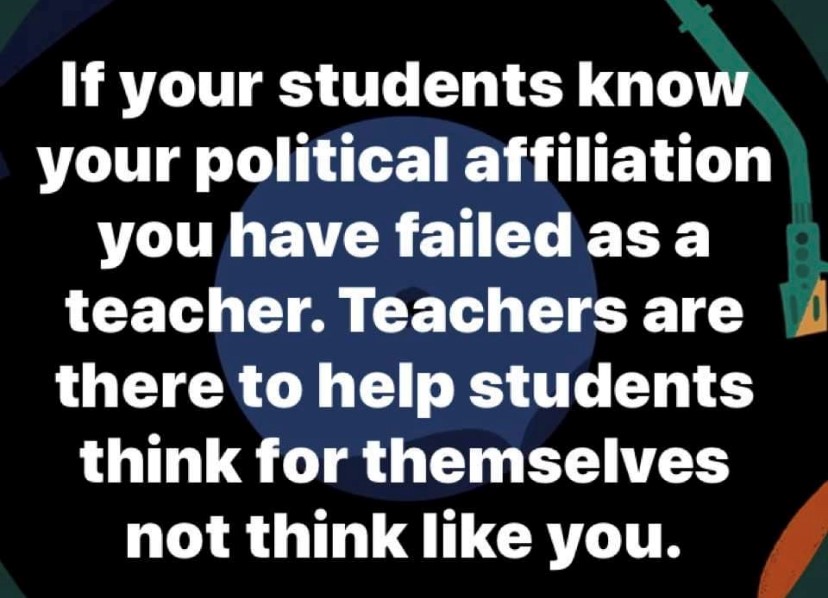
A month-or-so ago, a retired teacher in my PLN posted this meme:

I’m seeing a lot of this why-does-everything-have-to-be-about-politics, I-don’t-see-race, we-can-agree-to-disagree stuff from people, which I think is an attempt to shy away from some introspection and tough conversations.

But in this case, I happen to agree. I don’t want my students to ape my political beliefs. I would find it just as disturbing to hear them mindlessly repeating my own opinions back to me as I do when they recite the Pledge in unison like a bunch of zombies.

In my own ninth grade Pre-AP Biology 1 class, Mr. Sh—– spent hours of class time telling us about what an idiot Al Gore was and how George W. Bush was the only man fit to lead our country. He also told us that rap didn’t qualify as “music,” people who celebrated Halloween would go to Hell, and there were some serious reasons to doubt the validity of the theory of evolution. So while I didn’t learn much in the way of biology in the semester that I spent with him before begging my parents to let me drop down a level so that I wouldn’t have to be in his class, I did learn that children shouldn’t be forced to sit through an authority figure’s attempts to sway their political thinking.

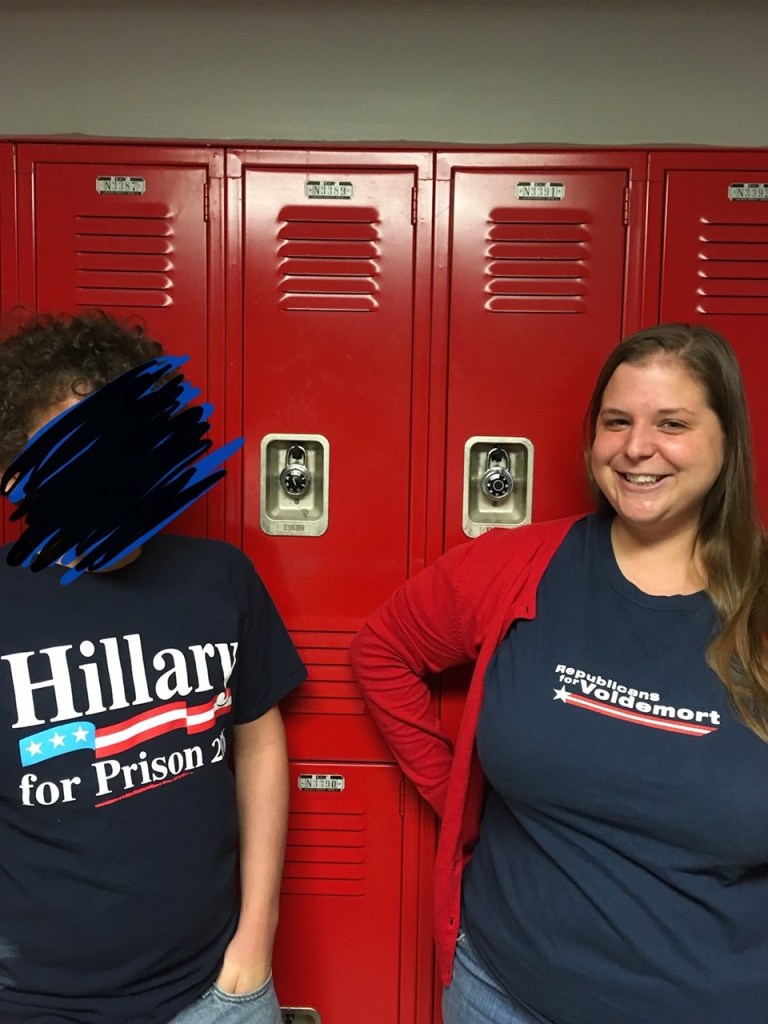
I don’t teach government, so I don’t tell my students for whom I’m voting or discuss which party best represents the laws and policies I hope to see in our country. (The exception being this shirt that I wore as a joke in 2016 in response to one of my students, and even now, upon reflection, I think that was a mistake and wouldn’t do it again.)

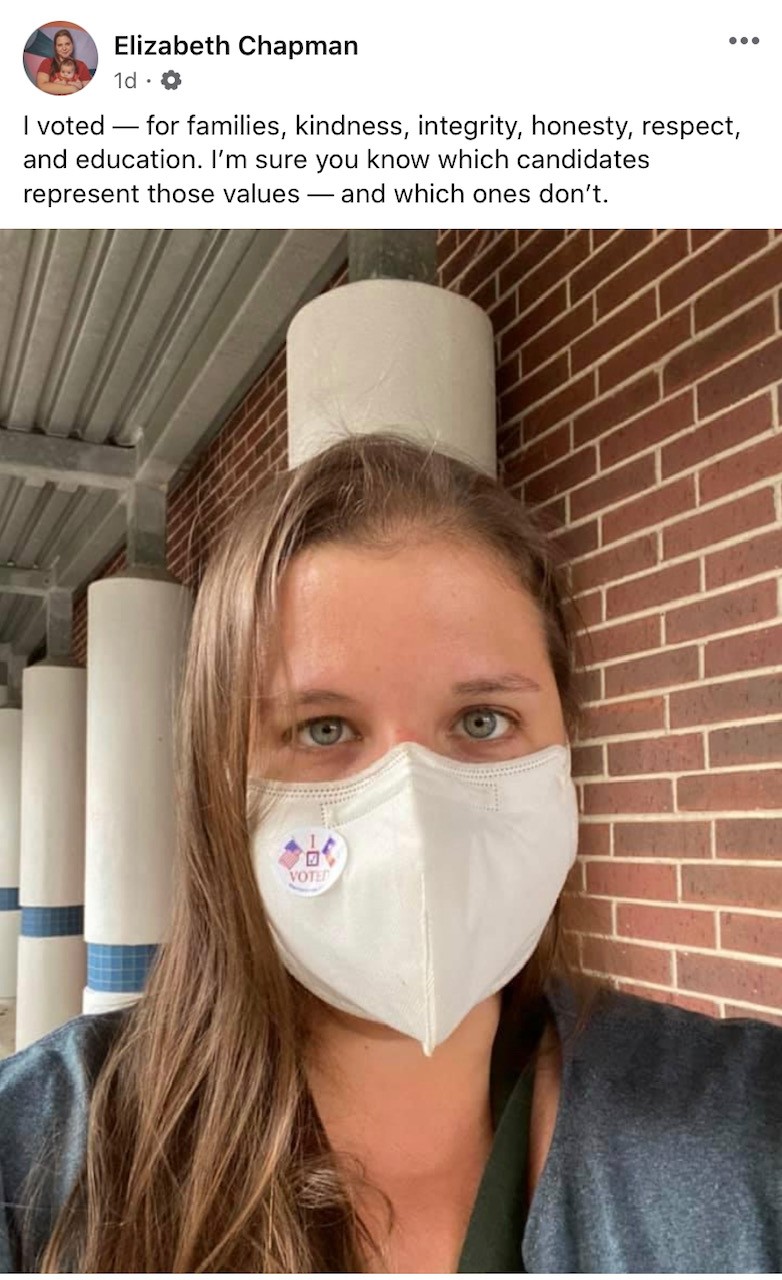
But here’s the thing; my students still know. So much has changed over the past four years I don’t need to say whom I’m voting for — statements like “racism is bad” and “making fun of someone with a disability is wrong” are now necessarily aligned with a particular side of the political spectrum.

So there’s where I won’t give ground. As a teacher, it’s not just within my scope of professional choice to make my classroom a place where we read about learn about people from different backgrounds, where every student feels safe and valued and respected, where we’re civil and kind in our conversation — it’s my obligation. And if a particular candidate or movement or party defines itself in opposition to those values, the problem lies with them and not me.

Soap Box

On Pregnancy and Schools

1.

I was pregnant in the same year as one of my students. I was twice her age (14) and then some. She had her baby first so that on the day that she stayed after class to tell me that it was just so hard for her to finish her homework while caring for her newborn son I was myself entirely not up to the task of grading that homework because I needed to get up from my desk every ten minutes and contemplate puking in the classroom trashcan.

2.

Once, when I was in fourth grade, I finished my work early (as usual) and picked up the book I was reading for fun. There was a word I didn’t know, so I went up to Ms. Maricle at the teacher’s desk and asked her what it meant. She gave me a concerned look and told me to ask my parents. But then, about ten minutes later, she called me back up and said, “‘Abortion’ is when a woman removes a pregnancy from her body.”

3.

Supreme Court Justice Ruth Bader Ginsburg passed away 24 days ago, 46 days before the 2020 U.S. presidential election. In spite of the refusal to consider Obama Supreme Court nominee Merrick Garland to fill Antonin Scalia’s seat nine months before the 2016 election, Senate Republicans quickly affirmed their commitment to push Trump’s nominee through a vote. That nominee, Amy Coney Barrett, is widely believed to be the vote that would overturn Roe v. Wade, should she be confirmed.

4.

What would I do, I wondered at age 14, if I became pregnant? It was a mostly hypothetical question given that I had only held a boy’s hand at the awards ceremony for our state Latin competition, but I had a lingering anxiety over the possibility of insemination via public toilets. I imagined jumping off a cliff or opening my wrists or any other of the dramatic ways I had seen in the movies of ending my life along with the one inside of me. I could not imagine telling my parents, who had made it clear that their position was that sex before marriage was immoral in spite of an anecdote they liked to tell about my mother burning breakfast when they were dating that had me wondering what she was doing over at my father’s apartment so early in the morning.

5.

I knew from the moment that Ms. Maricle told me about it that I believed that abortion was choice that a woman should have, but when I finally became pregnant myself, my feelings changed. I don’t mean that I came to think that abortion was wrong but that I now understood it as a nuanced and complicated issue rather than an abstract thought experiment. After years of taking the pill, my fiancé and I were surprised and disappointed to find that we didn’t seem able to conceive. So when things finally worked, after check-ups and shots and procedures, I felt deeply guilty for feeling so physically and emotionally miserable. When I thought about everything that I was giving up to become a mother, I felt panicked and suffocated. (I had to quit taking my antidepressant during my pregnancy.) I couldn’t sleep more than an hour or two at a time. I developed ovarian cysts. The low, deep ache near my cervix never seemed to let up, and around month five, I lost feeling in my fingertips. And through it all, I thought — how could a woman endure this for a baby she didn’t even want?

6.

Project Self-Respect was the name of Clear Creek ISD’s sex education program, delivered to students over three days via their ninth grade biology classes. They showed us a slide show of close-up images of a gonorrhea infection that developed in a woman’s eye after she touched her face after touching a man’s penis. We watched a ‘90s VHS tape of a testimonial of a 16-year-old girl in the late stages of AIDS; her skeletal frame told us that she knew that she didn’t have much longer to live but that she wanted to pass along the message that abstinence was the only form of safe sex. The session concluded with the instructor telling us that condoms were essentially useless as preventing the spread of HIV.

7.

Although my daughter is only seventeen months old, I know that it is possible that she will someday be pregnant when she doesn’t want to be. I know it’s possible that she will experience a very much desired pregnancy but face the devastating news that the child she is nurturing will only experience a very brief time in this world full of suffering or that her own life would be in serious risk by carrying to term. During the time that I was growing her inside of me, I began to feel my duty to protect my tiny, beautiful miracle, and that didn’t stop once she joined me in this world, and I don’t expect it ever will – not when she’s fourteen or twenty-seven or thirty-nine. I never want her to be without the choice to be safe and healthy and happy.

8.

My student dropped the honors English class in which I had her, but I still sometimes saw her hanging around in the halls. I showed her a picture of my daughter when she was born, and she told me about her son. “Maybe you’ll have him someday, miss,” she told me. I thought about all of the conferences that I had had with mothers whose teenagers I taught and the realization upon talking to them that they were my age or younger. When I was in college, you had a toddler, I thought. When I was traveling through Europe, you were packing school lunches and helping with science fair.

9.

I believe that everyone who might become pregnant has a right to choose to have an abortion; but I don’t believe that the people who have sincerely worked through the moral calculations of this issue and arrived at a different answer than I did are evil or misogynistic or backwards. Instead, I feel like we should be united in the end goal of having fewer people who want or need abortions in the first place, and it’s obvious to me that schools plays a critical role in that dynamic through the disseminating information about pregnancy and its prevention, facilitating conversations about healthy relationships and consent, and supporting students in creating stable financial futures that will allow them to plan for their families. To me, those goals are pro-life.

Tool Box

Found Poetry: What I Would Like For You to Know about Me

On our second day together, I asked my ninth grade students to fill out a short survey; the last question was “What would you like for me to know about you?” I was glancing back over their answers today, and it just struck me that in the collective they formed this really beautiful portrait of what it is to be a 14-year-old kid starting high school in the middle of this tough year, so I did some cutting and pasting and assembled them into a poem:

What I Would Like for You to Know about Me

English is my favorite subject.
Football is my favorite sport.

I have ADD.
I'm dyslexic.
I can get distracted.

I've been playing an Xbox game which immerses you into the Greek World during the Peloponnesian War.
I go by Kate.
I'm a team player and a hard worker.
I learn the best from watching educational YouTube videos. 
I like soccer, and I also like adventures.
I am still trying to adapt to online learning, so I might make a lot of mistakes. I hope you will understand!

I can be very quiet at times, but I will open up eventually.
I have really bad anxiety, so I might have to contact you about a lot of stuff.
I have never been good at describing myself, but once we are in person I know that you'll get to know me really well!

I’m tall.
I am an athlete..
I'm not very patient.
I talk a lot.
I am a little bit shy.
I don't have any allergies.
I'm very glad to be here.

I lived in Africa for two years.
I have a dog named Beverly and a cat named Bonita.
I would like to have a career in business and law.
I've been an Indian classical dancer since I was 4.
I might ask lots of questions bc I want to make sure I have everything right.

I have struggled with grammar in the past. I also do not feel confident in my writing. 
I want to be a screenplay writer.
I want to like writing.

I'm a slow learner.
I am forgetful. 
I like reading, and I also foster cats.
My parents discourage fun.

I am very good with technology. (Very good.)
I will devour any book that is put in front of me.
I’m very curious and like to know about history.
I will work diligently to complete my work.
I've invented something.
I don't know anything I would like you to know about me.
If you ever need a translator for Spanish, it's my first language and I am more than happy to help.

I look forward to the school year with you.
Soap Box

Rediscovering the Magic of School

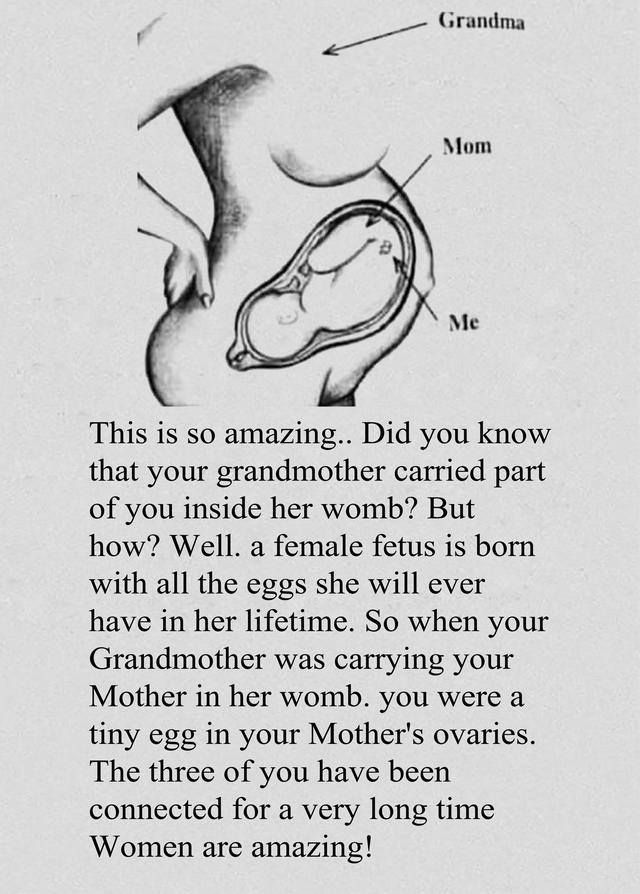
A very cool fact that I did NOT learn in my 9th grade Pre-AP Biology I class is that a woman who is pregnant is carrying the eggs of her future grandchildren.

That means that I (or half of me) was first exposed to the world of school in 1954, when my pregnant grandmother was teaching kindergarten. Her daughter – my mother – would become a teacher herself, and I can’t tell you how many weekends I played in her classroom while she prepared for her classes. Education was and is my mother’s vocation in the truest, Latinate sense of the word – her passion, her identity, her framework for making sense of the world.

So I like to joke to the parents who have come to visit my classroom on Open House that teaching, for me, is genetic. I have been steeped in the world of education for literally my entire existence. Over a Zoom meeting for a PD workshop, participants were asked to go around and introduce themselves by describing their hobbies. When it was my turn, I had to admit that I have no real hobbies outside of my work – just as it is for my mom, teaching and learning are just at the core of who I am.

But I have been delighted this past month to discover a dimension of the world of education totally unfamiliar to me up until now: the experience of being a parent in a school community.

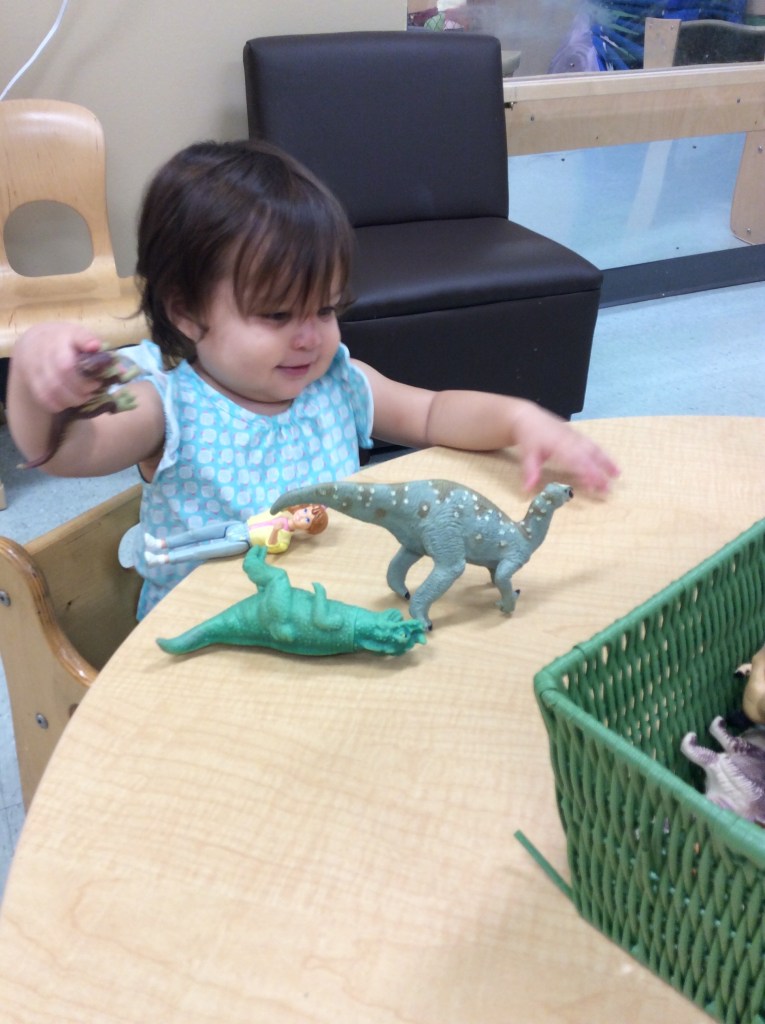
My brave, funny, generous, strong sixteen-month-old daughter started pre-school in August. Although her school has the two highest accreditations for an early childhood care center, when we enrolled her, we weren’t thinking about the curriculum. It was really because I needed her to be supervised – by someone other than me – so that I could get my own work done. (A baby makes a delightful guest star but a distracting recurring feature on virtual classes.)

And yet in that time, I have been delighted to discover her discovering the world each day with the support and guidance of her teachers. “Did you know that she can’t use a fork?!” her teacher asked me on the first day that I picked her up from school. “Well she’s too young,” I explained. “I’ve tried to teach her and given up for now.” And yet later that week, as we were eating dinner, she stole my fork and began to gobble up her noodles (with a few spills). She knows the Chinese word for “clap,” she can wash her own hands, she has invented some of her own dances. I can take credit for precisely zero of these things, but I am chuffed nonetheless. What a wonder schools are to take our children and help them to become the fullest versions of themselves. What wisdom and experience and patience and humor these teachers must possess to be able to grow our littlest people so well.

We got a note from the school today that told us they would be hosting a virtual book fair and our teacher would be compiling a wish list of books that they would like to add to their classroom library, and I want to buy every single item for her. What a blessing to be able to rediscover the magic of school after spending my life in it.

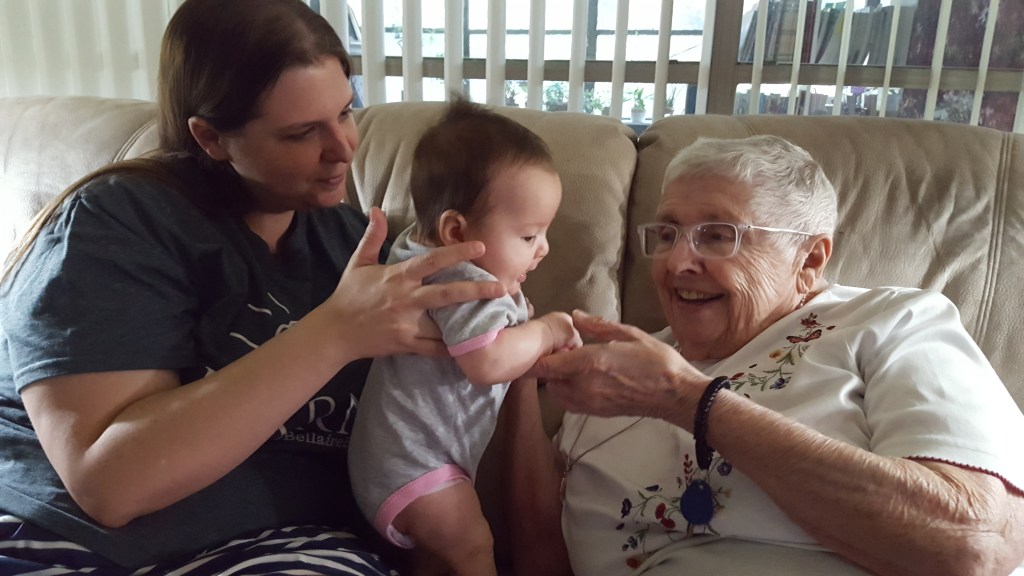
Suzanne getting to meet her great-grandmother, Lois, a former kindergarten teacher. If history is any indication, I expect that school will play just as big a role in Suzanne’s life as it has in the lives of her matrilineal ancestors.
Soap Box

Reclaiming My Time

In my third year of teaching, I needed to have some surgery, so I scheduled the procedure for the middle of October and planned to be out of my classroom for the three days I would need to recover.

Did I absolutely need to have it right then? another teacher asked me. Couldn’t I push it to the week of the Thanksgiving break? Leaving my students with a substitute for half a week, she said, was akin to malpractice unless it was truly life-threatening.

This past week marked my fifteenth year of teaching and my third week of pandemic-induced virtual instruction. And even though my family has been pretty cautious in terms of social distancing, I began to get worried when I developed a cough. A day later I had a sore throat, and then that same evening I found myself utterly exhausted and strangely chilled.

Yesterday morning, Saturday, I knew it was time for a COVID test. I held my head back as the nurse tickled my brain with a Q-tip and then waited in my car for the results. Fifteen minutes later, my phone rang, and they asked me to come back inside – the receptionist slide a piece of paper towards me from under the plexiglass. I was negative. I wasn’t incubating a lethal virus; it must have been the combination of allergies and stress and very long hours.

I felt relieved and worried at the same time. It was great that I didn’t have it – today – but what about our impending return to face-to-face instruction? If the demands of teaching can suppress my immune system and leave me feeling weak and drained, how is my body going to mount a defense against one of the worst respiratory viruses in history?

We have come to accept that an occupational hazard of teaching is the risk that it poses to our physical and mental health: in our shitty health insurance, in the stress of unreasonable workloads and performance targets, in the risk of death-by-mass-shooter that is becoming increasingly a feature of our workplace, in our sacrificial exposure to a lethal virus at the altar of the illusion of normalcy.

And these unreasonable expectations aren’t just coming from politicians, administration, and the community; we perpetuate them ourselves. We know that the system isn’t coming to save our kids, so we try to fill in the gaps – with our time, with our money, and with our hearts.

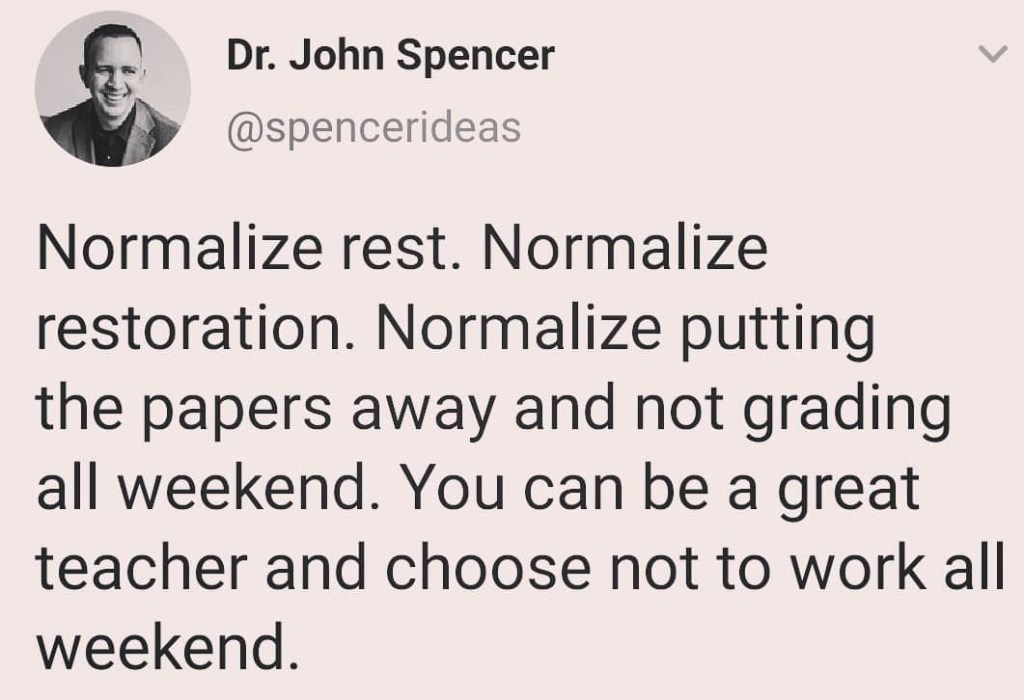
So I was thrilled to see trending over the last couple of weeks the argument that teachers need to prioritize self-care and establish some boundaries in terms of what we are willing to give to our work.

I’m opting into this. I need to be a healthy and whole person if I’m going to serve my students well over the long-term. I spent all of yesterday grading and planning lessons (after the COVID test), but this morning, I committed to not checking my email over the entire day. My baby and I went for a walk at the botanical gardens, then I made a lunch of spaghetti and meatballs from scratch which we enjoyed as a family. I read a book while she was napping and worked on a writing project while she and her baba watched Sunday afternoon football, and then we closed out the day with a picnic with my parents.

Tomorrow I’ll get back to the grind, and I’ll love it because teaching is what I do and who I am. So I’m not going to feel guilty about living in the hours beyond my job in a way that sustains my ability to do it.