Tool Box

Starting the Year with Xenia

One of the reasons that I love teaching ninth grade English at my school is that we get to start with what could be my favorite story of all time – Homer’s Odyssey.

You might have read the Odyssey as part of your own ninth grade curriculum – it’s a common text for the first year of high school – but if not, it’s an epic poem from Ancient Greece that tells the story of one man’s years-long journey to return to his family. Along the way, he encounters temptations and distractions and monsters of every sort, and as a result of those challenges, he becomes the person that he needs to be when he finally gets home; he knows what is important to him and he has the experience and the skills to make it happen.

It’s a fitting metaphor for beginning high school. (It’s a fitting metaphor for life.)

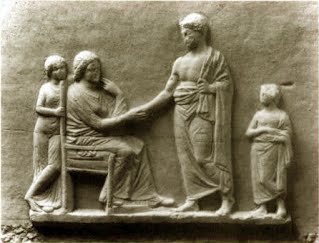
But beyond the quest archetype, another dimension of the story that I like is the absolute centrality of xenia. Xenia is sometimes explained as the Ancient Greek code of hospitality, but I think that it’s more than that; it was a whole ethos for how to be a person in their society. Some of the rules of xenia were:

  • If a traveler came to your home and requested hospitality, you were obliged to give it. No matter what they looked like! No matter what you thought of them! If a stinky, toothless, sore-encrusted beggar wearing tatters and rags knocked on your door, you welcomed them in because they might be a god in disguise.
  • You gave your guest the best of what you had to offer – the tastiest food, the liveliest entertainment (in the form of storytellers and musicians), the comfiest bed, the richest gifts. You did this all before asking your guest who they were and why they had come to you.
  • In return, your guest had to be willing to do the same for you, should you ever find yourself in their neighborhood.
  • These hospitality-based relationships were hereditary. Once you hosted or were hosted by someone, you became guest-friends. In the Iliad, the prequel to the Odyssey and the story of the Trojan War, two enemies meet on the battlefield and discover that one’s father once hosted the other’s, and they immediately stop fighting and give each other their armor as gifts.

The Greeks must have discovered that this was the recipe for forging a new relationship between strangers. They recognized that creating a new connection required some vulnerability on both sides, and so they developed this framework to support a more-or-less peaceful, stable social structure.

And as luck would have it, a more-or-less peaceful, stable social structure is also one of our goals for high school! I thought that perhaps the Greeks might be onto something and that their ideas about hospitality might help in onboarding our new 14-year-olds into our high school community.

So this year, I decided to establish my own xenia-based relationships with my 9th graders. I have invited them all to have afternoon tea with me during part of our school’s Cardinal Hour (our extended lunch period) in the hopes of creating lasting, meaningful connections with each of them.

Obviously, my students aren’t Olympian gods in disguise, but they do all possess latent powers of awesomeness that are sometimes disguised by the awkwardness of early adolescence. This time together, in small groups, has allowed me to get to know them in ways that would be difficult to do during our normal class time with 30-or-so other students. Over Tetley’s British Black Tea and Danish butter cookies, they tell me about whether they miss middle school or are thrilled to leave it behind, what kinds of pets they have (including a lemur!), how the rain makes them feel after Houston’s spate of catastrophic flooding, and so on.

Getting to spend an afternoon with my students and hearing their stories makes me feel fortunate to get to be a stop on their journeys.

Soap Box

STAAR Day

staarday2

It was a bright cold day in April, and the students were inside testing. Last Tuesday kicked off STAAR Season 2018 with the administration of the English 1 and 2 exams. In a month or so, we will test in Biology, Algebra, and U. S. History. Students are required to pass all of these to receive their high school diplomas.

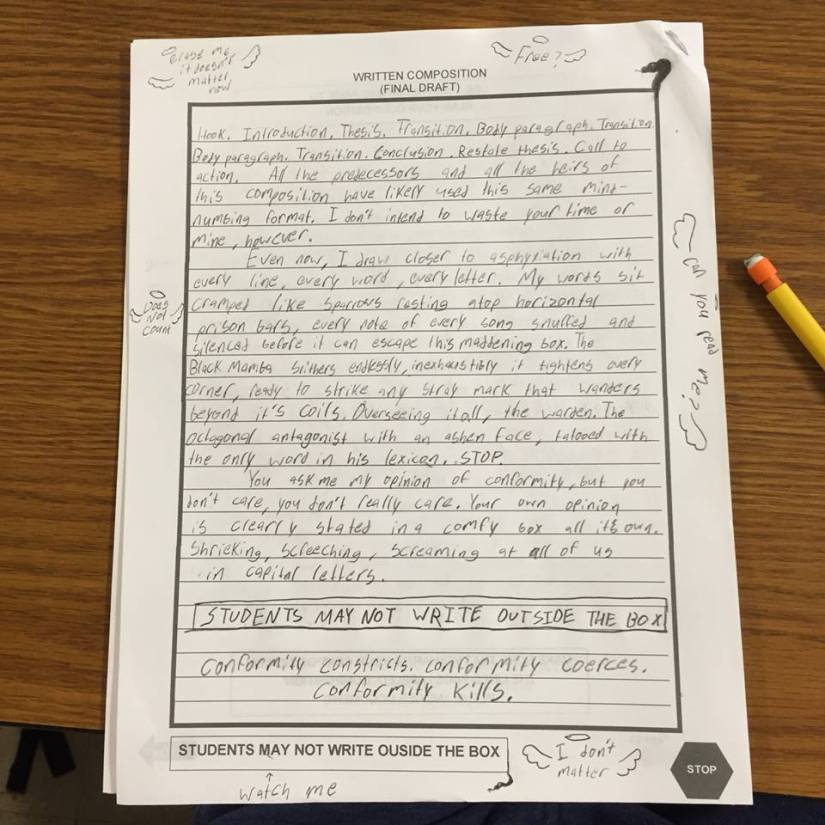
While my students were literally thinking inside the box (“the box” being the 7- by 10-inch rectangle that must contain their essay), I was in the library. I am on the Testing Team, which is like the Avengers, but instead of saving the world, we are complicit in its destruction.

staarday1

My specialty is seating charts. When teachers return from their five-hour sentence lugging a big box of forms and manuals and sundry other paper artifacts of the bureaucracy, they must give me their seating chart to scrutinize before they can pass onto the next stage of testing check-in. We have a form that we must use, with 30 neat little boxes, all in rows. What happens if the configuration of the room does not allow for a 5×6 grid-style layout? Well, you still have to put the students in the boxes, regardless of whether or not it bears any resemblance to the reality of the classroom.

“You have to write out the ENTIRE nine-digit booklet number on each of the 30 boxes,” I told the German teacher. “I know that it’s the SAME for the first seven digits, but you still have to do it.”

“I need the time that each of these students individually turned in their testing materials labelled on their boxes,” I said to a math teacher. “I KNOW that there’s not a spot for it, and I agree that there should be, but I don’t make the form. I don’t know WHY we have to do it, but we’ll get in trouble if we don’t. Just guess if you can’t remember.”

I tracked down a teacher who submitted a seating chart with a missing form number to ask her to account for the irregularity. She said that that student was the last to finish, and she was just so happy to be done with the test that she forgot to write it down. “Well, now I’M going to have to search through HUNDREDS of test books to find it,” I sniped.

This is not who I am – at least not on the 175-non-testing days in the instructional calendar. I swoon over novels. When I was in first grade, I got in trouble for not coloring inside the lines (literally). I have a bumper sticker that says “Teach Peace.”

But I am guilty of having been obedient. If I were a better, braver person, I would refuse to be a part of a system that I know is not only broken but bankrupt. I would set those boxes of tests on fire.

“How did the test go?” I asked my students the day after the exam.

“It went well,” said Ben. “Except I couldn’t think of any concrete examples for my essay.”

“What?!”

“Haha, just kidding.”

“Thank goodness.”

“I wrote a poem in German. And I composed it entirely in the margins, outside of the box.”

“…Okay,” I said, and I meant it.

Soap Box

Bullet Points

When the loudspeaker crackled on and announced that our school was having an active shooter drill and we were to go into lockdown, I whispered the word “fuck” from the shot of adrenaline to my heart in front of my class of 37 ninth-grade students. This was hilarious, at least if you are 15 years old.

My classroom doesn’t have windows, so when we turn out the lights, you can’t see a foot in front of your face. This is also very funny to my students. Who might be kissing in the dark? We had better all giggle about it.

Lockdown procedure calls for absolute silence, a protocol that my students took as a mild suggestion. I hissed at them to turn off their phones and close their mouths.

So we sat in the dark and the silence imagining what if a mass murderer with the means to kills hundreds of people in a matter of minutes were loose in our school. Where would the bullets hit us? In the leg, in the face, in the gut? What does a pool of real blood look like? Is it the same as in the movies? Who would get lucky? Who would sacrifice themselves? Whose parents were in for the worst phone call of their lives?

A sharp bang and a rattle burst from my classroom door and caught my heart and hooked it up into my throat: some anonymous administrator, checking to make sure that the lock was secure. I thought about how the door would make that same sound if the person on the other side of it had a gun. None of my students laughed at this.

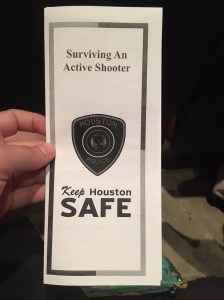
Later that afternoon, our faculty had “Surviving an Active Shooter” training in the auditorium. A Houston Police Department specialist in mass shootings delivered some bullet-point tips on what we could do to protect ourselves and our students:

bulletpoints1

  • Consider what everyday classroom items could be used as deadly weapons to defend against your attacker. That red pen you use to grade student essays is capable of paralyzing a man if applied to the spinal column. The scissors you had on your desk for cutting off the bottom halves of permission slips should be stabbed into the attacker’s shooting arm.
  • After you have taken down the attacker through grievous bodily injury, take the plastic bag from your trashcan and wrap it around his head to cut off oxygen and minimize the chances of him getting back up.
  • Be prepared to practice first-aid until emergency services arrive. A computer cord can be used as a makeshift tourniquet. A thin piece of plastic – say, a candy wrapper – could be used to slow the blood loss from a child’s sucking chest wound.
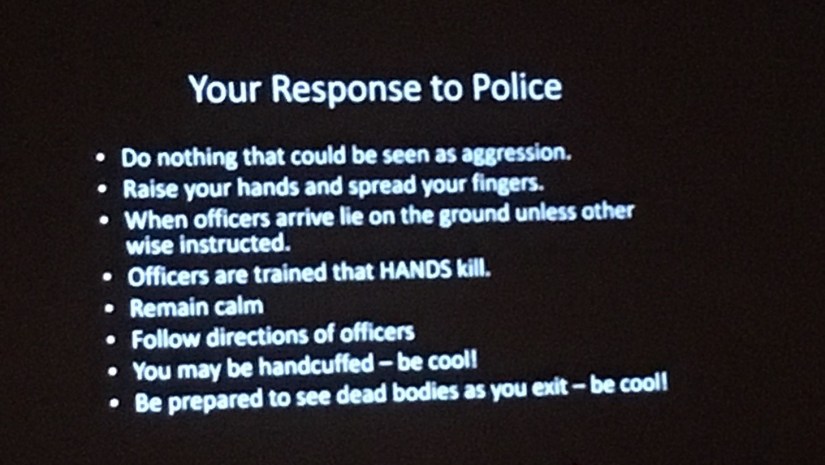
  • Try to do all of this without the use of your hands. Police officers are trained to see hands as a threat, so make sure that yours are empty and held up so that you are not mistaken for the active shooter.
  • “You may be handcuffed – be cool!”
  • “Be prepared to see dead bodies as you exit – be cool!”

bulletpoints2

Implicit in all of this advice and in the lockdown drill was the assumption that our protocol for protecting our children from lunatics with guns kicks in after they have stepped foot on campus. Teachers – not gun owners, not the firearms industry, not legislators – are being asked to shoulder the burden of reckoning with the perfect storm caused by white, male entitlement and massacre-grade weaponry.

I think that the sound of the door handle rattling as we imagined our deaths will stay with me for the rest of my life. I keep wondering, if there were really a shooter, would the door hold? There ought to be a lot more than a flimsy piece of plywood standing between a killer and our kids.