Soap Box

The 2% Principle

I went to college at a very large state university known for its conservative politics, its fanaticism about football, its ties to the military, and its love of tradition. So I fit right in (not).

I heard that the term for a person like me — someone who chose not to invest in the campus life beyond academics — was a “two-percenter” (owing, I guess, to the proportion of the student body that we made up).

Le lait, c’est moi.

Because I had earned lots of college credit in high school, it only took me three semesters to graduate, but that time felt interminable, and it was one of the loneliest periods of my life. I still feel wistful when other people reminisce about their college years, but it’s made me appreciate what a blessing it is to be able to be a part of a community where I do feel that I belong.

Everything that was missing from my college experience is a part of my daily life at the high school where I have now taught for eight years: values that I share, a sense of purpose, a community of supportive peers. When I get to campus each day, I don’t feel as though I’m just putting in my time — instead I’m investing in a group of people whom I care about.

I’ve come to think of one of the ways in which I try to do this as my “two percent principle.” There are almost 4,000 people in our school, each faced with their own individual and systemic challenges. I want to be a positive force in those lives, but I know there’s no way that I can create enormous, significant changes in all of the complicated dynamics of our social system every single day.

So instead, I look for ways to make people’s days two percent better. These are tiny, quick actions that don’t take a lot of planning. They can be spontaneous, they have to be intentional, and they’re usually things that fall outside of a strict understanding of one’s official job responsibilities.

For example, this week we’re giving the SAT and the PSAT. Proctoring a standardized test is a shitty, miserable gig at the best of times; a life-threatening pandemic hasn’t done anything to improve the experience. So last night I watched the new version of Emma on HBO and packaged up 125 tiny bags of Halloween candy to put inside the testing boxes along with the bubble sheets and materials control forms and seating chart and testing script and so on.
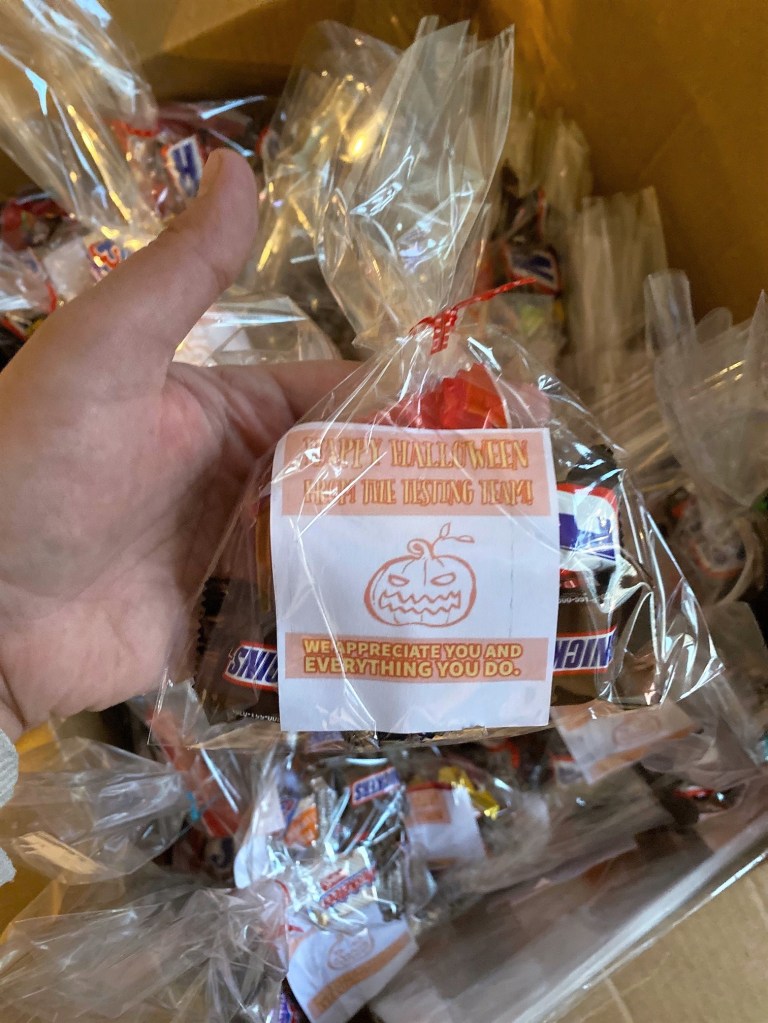
No teacher is going to experience a peripeteia in their narrative arc as a result of getting a bag of cheap chocolates. But maybe the loss of instructional time, potential for exposure to a deadly disease, mind-numbing tedium, and sense of despair at the absurdity of the standardized testing industry will suck less (maybe two percent less) with some token sweets and a note saying “I see you.”

When I think about what makes my days two percent better, it’s often in the moments that others take to connect with me. As I’m winding down for the evening, it’s such a pleasure to be able to linger over the minutes in which someone took to check in on me or share a confidence or point out a win that I had. I love how my district’s new chat application makes this possible for me to do with my students:

Framing the difference that I hope to make in terms of the accumulation of lots of little two-percent interactions over all of my days is something that is helping me to feel like I have some control and influence in this awful year. And I can’t help but feel like if just five or ten people had tried to make a two-percent difference in my life when I was a student in college, my entire experience there might have been a good one.

Soap Box

Back-to-Basics

You know the feeling you get when you wake up in a hotel room and for the first few seconds of consciousness, you’re very confused about where you are?

That’s been every day of 2020 since March. I don’t use an alarm clock anymore because my baby is the alarm clock, and for those first bleary-eyed moments in the dark as I’m coming up from my dreams, I’ve forgotten when we are until it comes rushing back to me – the pandemic, the isolation, the anxiety, the 57 precautions I now need to take going about my day.

Just one of the ways in which my world has been totally upended was in our shift to virtual learning. I have been in a physical school continuously, in some capacity, for the past three decades.

And yet, changing the form of school in such a fundamental way has been, for me, a largely positive experience. Now that I have the urgency to make them work, I’m delighted and amazed by all of the possibilities offered by the myriad tech tools. Because of our new time constraints, I’m rethinking virtually everything about my role and my work in the classroom.

At the same time, I’m still craving the familiarity and the comfort of life-before-COVID. And upon reflection at the end of our first grading cycle, I think my students are too.

So instead of a list of new ideas, approaches, pieces of technology, etc., here are a few traditional school practices that I have found that have continued to be valuable:

  1. Calling roll. Do I need to call roll? I do not. I can download a list of everybody who attended our live session in a matter of seconds. It’s time-consuming (taking up 10 of my precious 50 minutes every-other-day) and has no instructional value. But given the universal difficulty of getting students to participate via virtual platforms, I’ve found that there’s a payoff to reminding students at the start of class that they do have a microphone and that it does work. Furthermore (and I can’t take credit for this idea – someone in my PLN came up with it), I’ve been using it as an excuse to ask students to share something that gives me a sense of who they are instead of just saying “here.” Someone suggested asking students to share a piece of good news; I’ve also had luck with asking them to tell me something they’re grateful for or something they’re excited about as well as using one of those silly which-one-are-you? memes.
  2. Reading out loud. I didn’t even do this prior to The Great Disaster That Is 2020. We didn’t have time. I needed to teach grammar, various genres of writing, vocabulary, test-taking strategies as well as have options for creative expression, incorporate opportunities for group work, build students’ social and emotional skills, form trusting and safe relationships with each individual kid, and oh yeah, actually discuss the literature. But I knew that if it was a struggle to get my students to read at home in 2019, it sure-the-heck would be now. So even though my instructional time has been cut in half, I made similar cuts to my texts, and now a chunk of each day is story time. But this necessity has turned out to be a surprise win because it’s forcing my students to slow down and be present. We’re using “my” time and not “theirs,” so there’s no reason to rush. And I can tell from their responses that they’re catching more than they usually do when reading is primarily silent and independent. I’ve recently started to break the dialogue into roles and ask them to help me while I do the “narration,” and that makes it even more engaging.
  3. Presentations. Like teachers everywhere, I have been pulling my hair out over how quiet and unresponsive my students were at the beginning of the year. They weren’t responding to my questions, they weren’t reacting to my jokes. But once I ceded the floor in its entirety by telling them that they needed to share something of value with the rest of the class, they started to shine. I think this works for a number of reasons: 1) they get time to prepare exactly what they want to say instead of being put on-the-spot, 2) they get to work with others (and practice talking through their topic in a small, trusted group before doing it in front of everyone), 3) by making it a “grade” (because everyone’s getting a 100, even though I don’t tell them that), it gives them the excuse to try.
  4. Right-and-wrong answers. This one is kind of a cheat because I’ve primarily doing this through EdPuzzle. I find or create videos that cover some of the content I need students to know, and then I splice in dead-easy multiple choice questions with only two answers (one of which is usually very obviously incorrect). When I asked my students what has been working well for them this year, this is what they’re most enthusiastic about. Why? My hypothesis is because we all need opportunities to do some lower-level thinking (and feel successful and productive in it). Just like grading technology-rich, multi-faceted product of a student’s original design can be both rewarding and exhausting for teachers, creating work like that take a lot out of our students, and doing that everyday, in all your classes, during the apocalypse is too much.
  5. Lecture. I said it. I’ve said it before. I’ll say it again. Lectures have a place in teaching and learning. Not the only place, not the most important place, but they deserve to be a tool in any skilled educator’s repertoire. But why is lecture a particularly effective strategy in this moment? Because while I think it is always satisfying to have an expert in a particular discipline guide you in an organized and systematic way through an unfamiliar body of knowledge, 2020 is particularly lacking in such encounters with credible authority. An anarchical free-for-all with regard to knowledge is part of what got us into this mess (in terms of the notion that all opinions on science and epidemiology and public health policy are equally valid). I can’t tell my students that everything is going to be okay or that they need to follow this set of steps to stay healthy or that democracy as-we-know-it will continue to exist post-November, but I can tell them about how Ancient Greek ideas about the underworld impacted their cultural values and how we see those dynamics play out in the choices characters make in Classical works of literature.
Soap Box

Happy Indigenous People’s Day

(I tried posting this on October 12, but it looks like it didn’t go through for some reason!)

Happy Indigenous People’s Day! ❤️

I began my career as a seventh grade English and Texas History teacher, and throughout those years I had the privilege to learn all about the many diverse and rich communities of Native Texans — the Karankawa, when I have lived almost my entire life, spanning the lands between today’s Houston and Galveston; the Coahuiltecans in the Rio Grande Valley; the Caddo of East Texas; and the Apache and Comanche in the plains of the Hill Country and the west. (And there are even more tribes!)

I loved learning and teaching about their architecture and their crafts and their religions and their political structures. The land that makes up Texas had been full of complex and meaningful human civilization for thousands of years by the time that Spaniards set foot on it. (And it was full of the descendants of those Native people when the United States annexed it following the Mexican-American War.)And because I am a teacher in my truest heart, I would like to share some of my favorite facts about these great cultures!

🌎 The Coahuiltecans could CHASE DOWN A DEER ON FOOT. They would just run after it until it became exhausted.
🌎 The Caddo were part of the Mississippi mound building cultures. They built these enormous earthen structures, but their purpose is a mystery (to us).

🌎 The Karankawa had pet dogs!

🌎 The Comanche could, using only the strength of their legs, swing their bodies underneath their galloping horses and shoot arrows upside down!

🌎 The real first Thanksgiving (the first instance of Native people offering Europeans assistance and hospitality) actually took place centuries before the Pilgrims in West Texas.

Of course, there’s so much that we don’t know about the history of these people, but I think it’s important to take a moment to sit with what we DO know. And I think it’s even more important that we apply those understandings to solving issues of inequity that Native people face today. (For example, Native women are assaulted, murdered, or disappeared at rates higher than any other group in America.) After all, who could disagree with teaching and learning about “our diverse history and all who have contributed to shaping this Nation?”

Soap Box

Teaching in an Election Year

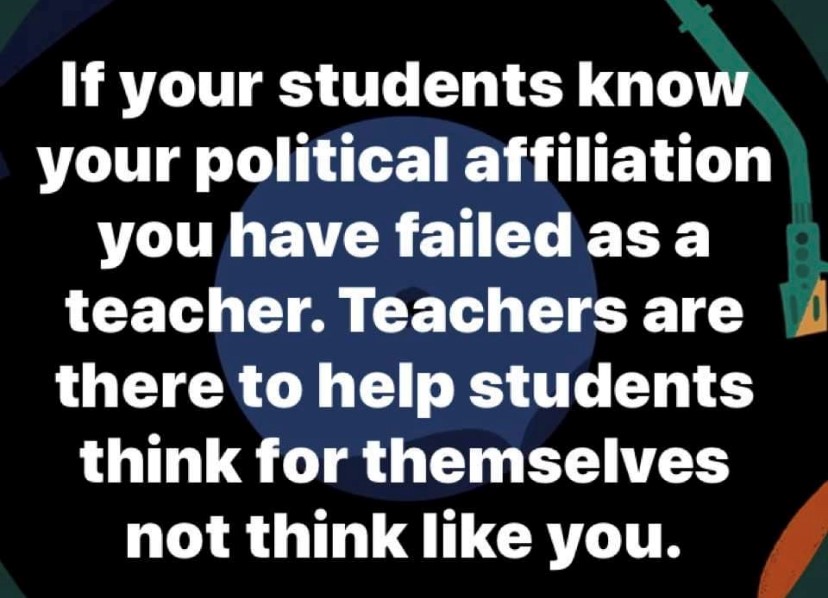
A month-or-so ago, a retired teacher in my PLN posted this meme:

I’m seeing a lot of this why-does-everything-have-to-be-about-politics, I-don’t-see-race, we-can-agree-to-disagree stuff from people, which I think is an attempt to shy away from some introspection and tough conversations.

But in this case, I happen to agree. I don’t want my students to ape my political beliefs. I would find it just as disturbing to hear them mindlessly repeating my own opinions back to me as I do when they recite the Pledge in unison like a bunch of zombies.

In my own ninth grade Pre-AP Biology 1 class, Mr. Sh—– spent hours of class time telling us about what an idiot Al Gore was and how George W. Bush was the only man fit to lead our country. He also told us that rap didn’t qualify as “music,” people who celebrated Halloween would go to Hell, and there were some serious reasons to doubt the validity of the theory of evolution. So while I didn’t learn much in the way of biology in the semester that I spent with him before begging my parents to let me drop down a level so that I wouldn’t have to be in his class, I did learn that children shouldn’t be forced to sit through an authority figure’s attempts to sway their political thinking.

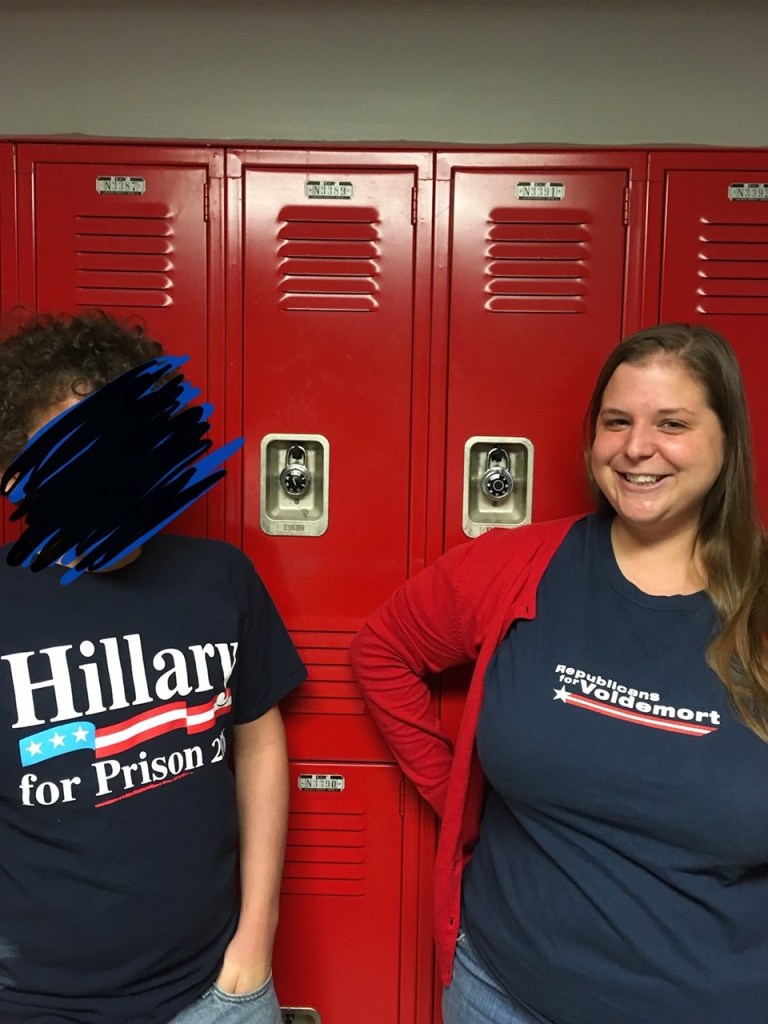
I don’t teach government, so I don’t tell my students for whom I’m voting or discuss which party best represents the laws and policies I hope to see in our country. (The exception being this shirt that I wore as a joke in 2016 in response to one of my students, and even now, upon reflection, I think that was a mistake and wouldn’t do it again.)

But here’s the thing; my students still know. So much has changed over the past four years I don’t need to say whom I’m voting for — statements like “racism is bad” and “making fun of someone with a disability is wrong” are now necessarily aligned with a particular side of the political spectrum.

So there’s where I won’t give ground. As a teacher, it’s not just within my scope of professional choice to make my classroom a place where we read about learn about people from different backgrounds, where every student feels safe and valued and respected, where we’re civil and kind in our conversation — it’s my obligation. And if a particular candidate or movement or party defines itself in opposition to those values, the problem lies with them and not me.

Soap Box

On Pregnancy and Schools

1.

I was pregnant in the same year as one of my students. I was twice her age (14) and then some. She had her baby first so that on the day that she stayed after class to tell me that it was just so hard for her to finish her homework while caring for her newborn son I was myself entirely not up to the task of grading that homework because I needed to get up from my desk every ten minutes and contemplate puking in the classroom trashcan.

2.

Once, when I was in fourth grade, I finished my work early (as usual) and picked up the book I was reading for fun. There was a word I didn’t know, so I went up to Ms. Maricle at the teacher’s desk and asked her what it meant. She gave me a concerned look and told me to ask my parents. But then, about ten minutes later, she called me back up and said, “‘Abortion’ is when a woman removes a pregnancy from her body.”

3.

Supreme Court Justice Ruth Bader Ginsburg passed away 24 days ago, 46 days before the 2020 U.S. presidential election. In spite of the refusal to consider Obama Supreme Court nominee Merrick Garland to fill Antonin Scalia’s seat nine months before the 2016 election, Senate Republicans quickly affirmed their commitment to push Trump’s nominee through a vote. That nominee, Amy Coney Barrett, is widely believed to be the vote that would overturn Roe v. Wade, should she be confirmed.

4.

What would I do, I wondered at age 14, if I became pregnant? It was a mostly hypothetical question given that I had only held a boy’s hand at the awards ceremony for our state Latin competition, but I had a lingering anxiety over the possibility of insemination via public toilets. I imagined jumping off a cliff or opening my wrists or any other of the dramatic ways I had seen in the movies of ending my life along with the one inside of me. I could not imagine telling my parents, who had made it clear that their position was that sex before marriage was immoral in spite of an anecdote they liked to tell about my mother burning breakfast when they were dating that had me wondering what she was doing over at my father’s apartment so early in the morning.

5.

I knew from the moment that Ms. Maricle told me about it that I believed that abortion was choice that a woman should have, but when I finally became pregnant myself, my feelings changed. I don’t mean that I came to think that abortion was wrong but that I now understood it as a nuanced and complicated issue rather than an abstract thought experiment. After years of taking the pill, my fiancé and I were surprised and disappointed to find that we didn’t seem able to conceive. So when things finally worked, after check-ups and shots and procedures, I felt deeply guilty for feeling so physically and emotionally miserable. When I thought about everything that I was giving up to become a mother, I felt panicked and suffocated. (I had to quit taking my antidepressant during my pregnancy.) I couldn’t sleep more than an hour or two at a time. I developed ovarian cysts. The low, deep ache near my cervix never seemed to let up, and around month five, I lost feeling in my fingertips. And through it all, I thought — how could a woman endure this for a baby she didn’t even want?

6.

Project Self-Respect was the name of Clear Creek ISD’s sex education program, delivered to students over three days via their ninth grade biology classes. They showed us a slide show of close-up images of a gonorrhea infection that developed in a woman’s eye after she touched her face after touching a man’s penis. We watched a ‘90s VHS tape of a testimonial of a 16-year-old girl in the late stages of AIDS; her skeletal frame told us that she knew that she didn’t have much longer to live but that she wanted to pass along the message that abstinence was the only form of safe sex. The session concluded with the instructor telling us that condoms were essentially useless as preventing the spread of HIV.

7.

Although my daughter is only seventeen months old, I know that it is possible that she will someday be pregnant when she doesn’t want to be. I know it’s possible that she will experience a very much desired pregnancy but face the devastating news that the child she is nurturing will only experience a very brief time in this world full of suffering or that her own life would be in serious risk by carrying to term. During the time that I was growing her inside of me, I began to feel my duty to protect my tiny, beautiful miracle, and that didn’t stop once she joined me in this world, and I don’t expect it ever will – not when she’s fourteen or twenty-seven or thirty-nine. I never want her to be without the choice to be safe and healthy and happy.

8.

My student dropped the honors English class in which I had her, but I still sometimes saw her hanging around in the halls. I showed her a picture of my daughter when she was born, and she told me about her son. “Maybe you’ll have him someday, miss,” she told me. I thought about all of the conferences that I had had with mothers whose teenagers I taught and the realization upon talking to them that they were my age or younger. When I was in college, you had a toddler, I thought. When I was traveling through Europe, you were packing school lunches and helping with science fair.

9.

I believe that everyone who might become pregnant has a right to choose to have an abortion; but I don’t believe that the people who have sincerely worked through the moral calculations of this issue and arrived at a different answer than I did are evil or misogynistic or backwards. Instead, I feel like we should be united in the end goal of having fewer people who want or need abortions in the first place, and it’s obvious to me that schools plays a critical role in that dynamic through the disseminating information about pregnancy and its prevention, facilitating conversations about healthy relationships and consent, and supporting students in creating stable financial futures that will allow them to plan for their families. To me, those goals are pro-life.

Soap Box

Rediscovering the Magic of School

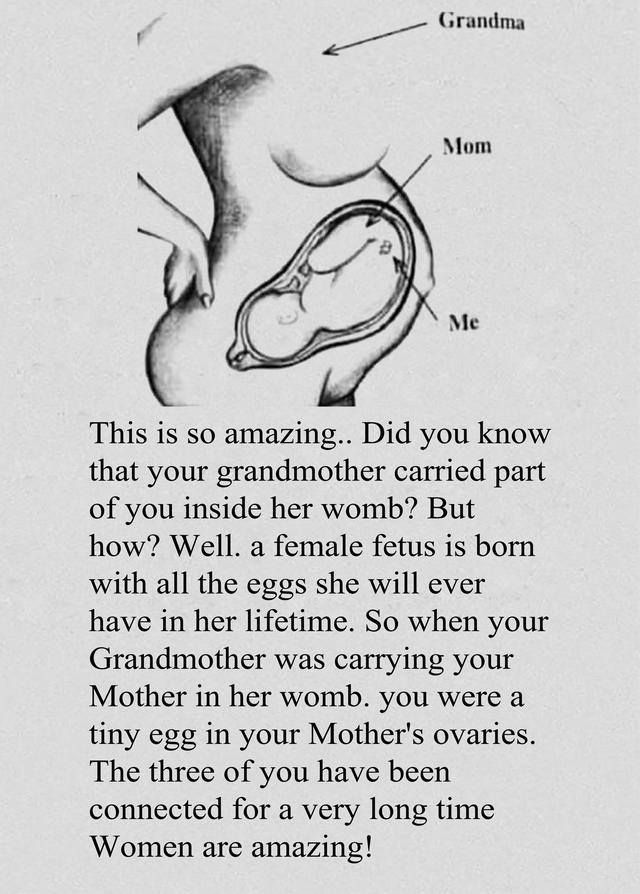
A very cool fact that I did NOT learn in my 9th grade Pre-AP Biology I class is that a woman who is pregnant is carrying the eggs of her future grandchildren.

That means that I (or half of me) was first exposed to the world of school in 1954, when my pregnant grandmother was teaching kindergarten. Her daughter – my mother – would become a teacher herself, and I can’t tell you how many weekends I played in her classroom while she prepared for her classes. Education was and is my mother’s vocation in the truest, Latinate sense of the word – her passion, her identity, her framework for making sense of the world.

So I like to joke to the parents who have come to visit my classroom on Open House that teaching, for me, is genetic. I have been steeped in the world of education for literally my entire existence. Over a Zoom meeting for a PD workshop, participants were asked to go around and introduce themselves by describing their hobbies. When it was my turn, I had to admit that I have no real hobbies outside of my work – just as it is for my mom, teaching and learning are just at the core of who I am.

But I have been delighted this past month to discover a dimension of the world of education totally unfamiliar to me up until now: the experience of being a parent in a school community.

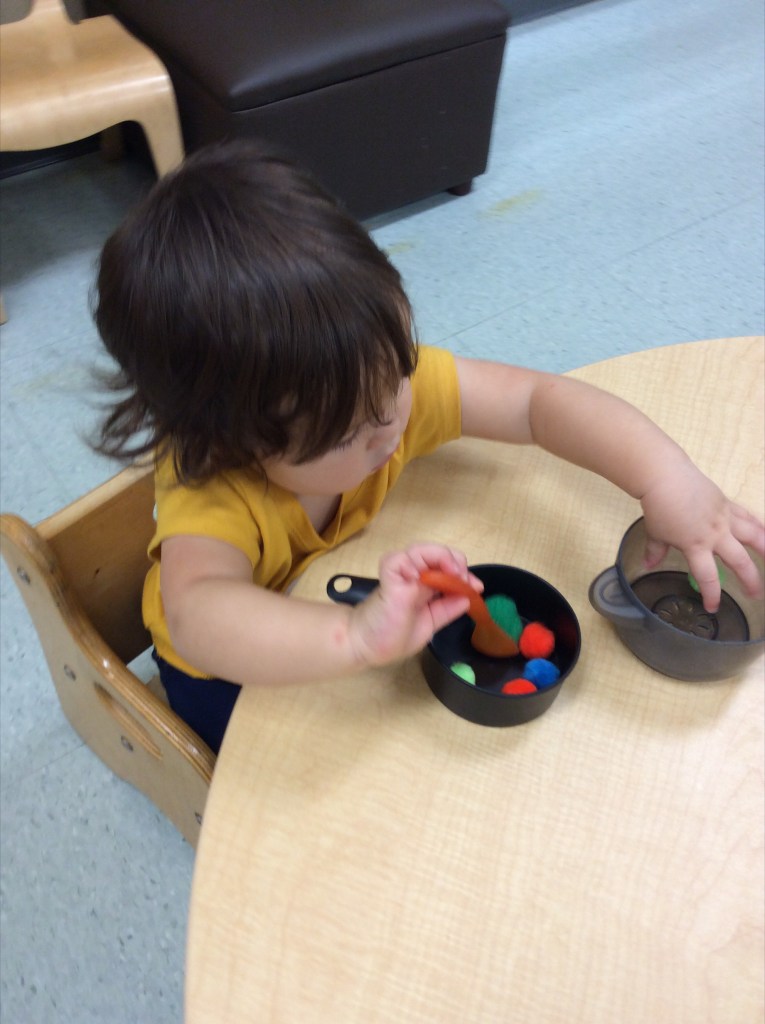
My brave, funny, generous, strong sixteen-month-old daughter started pre-school in August. Although her school has the two highest accreditations for an early childhood care center, when we enrolled her, we weren’t thinking about the curriculum. It was really because I needed her to be supervised – by someone other than me – so that I could get my own work done. (A baby makes a delightful guest star but a distracting recurring feature on virtual classes.)

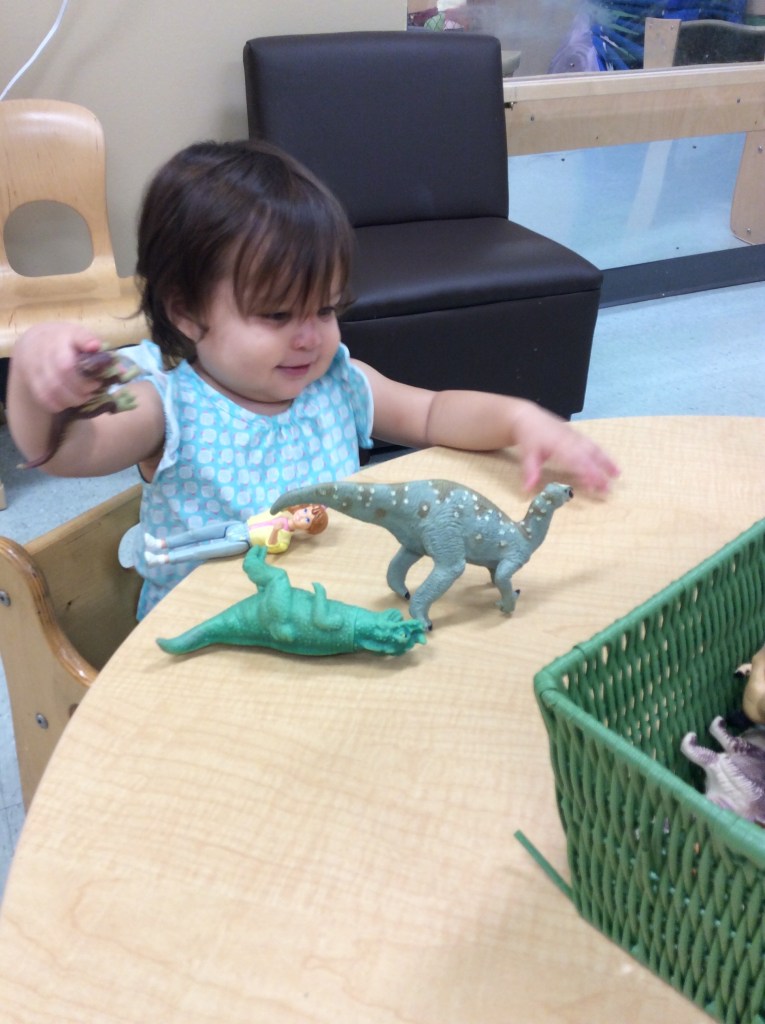
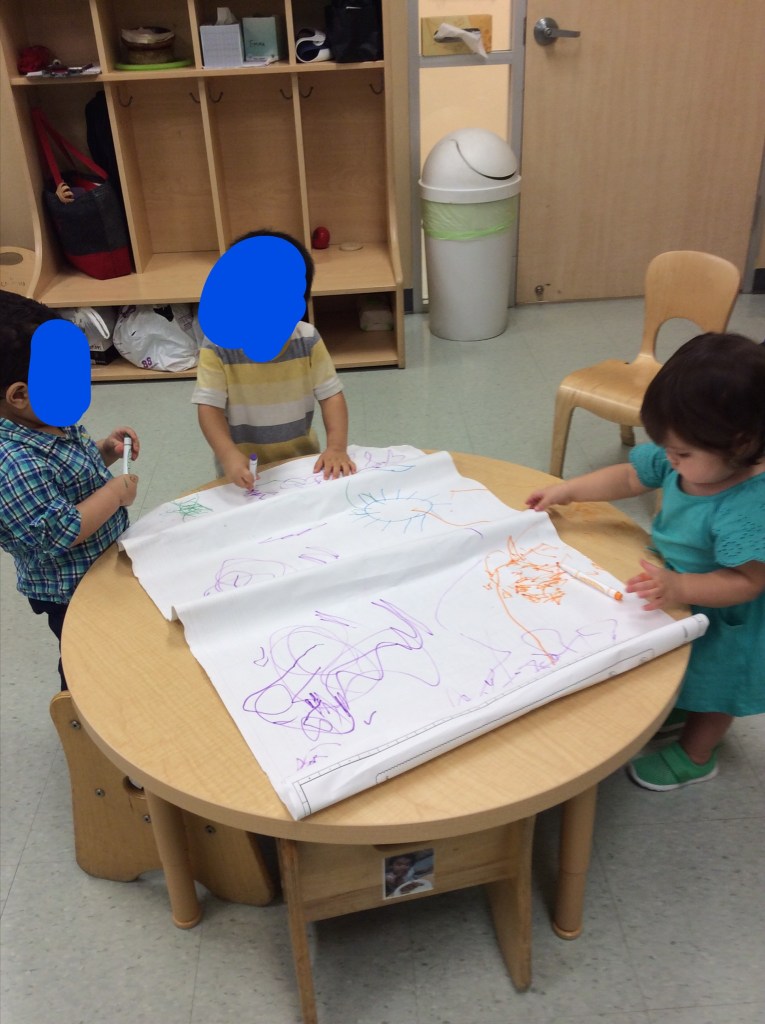
And yet in that time, I have been delighted to discover her discovering the world each day with the support and guidance of her teachers. “Did you know that she can’t use a fork?!” her teacher asked me on the first day that I picked her up from school. “Well she’s too young,” I explained. “I’ve tried to teach her and given up for now.” And yet later that week, as we were eating dinner, she stole my fork and began to gobble up her noodles (with a few spills). She knows the Chinese word for “clap,” she can wash her own hands, she has invented some of her own dances. I can take credit for precisely zero of these things, but I am chuffed nonetheless. What a wonder schools are to take our children and help them to become the fullest versions of themselves. What wisdom and experience and patience and humor these teachers must possess to be able to grow our littlest people so well.

We got a note from the school today that told us they would be hosting a virtual book fair and our teacher would be compiling a wish list of books that they would like to add to their classroom library, and I want to buy every single item for her. What a blessing to be able to rediscover the magic of school after spending my life in it.

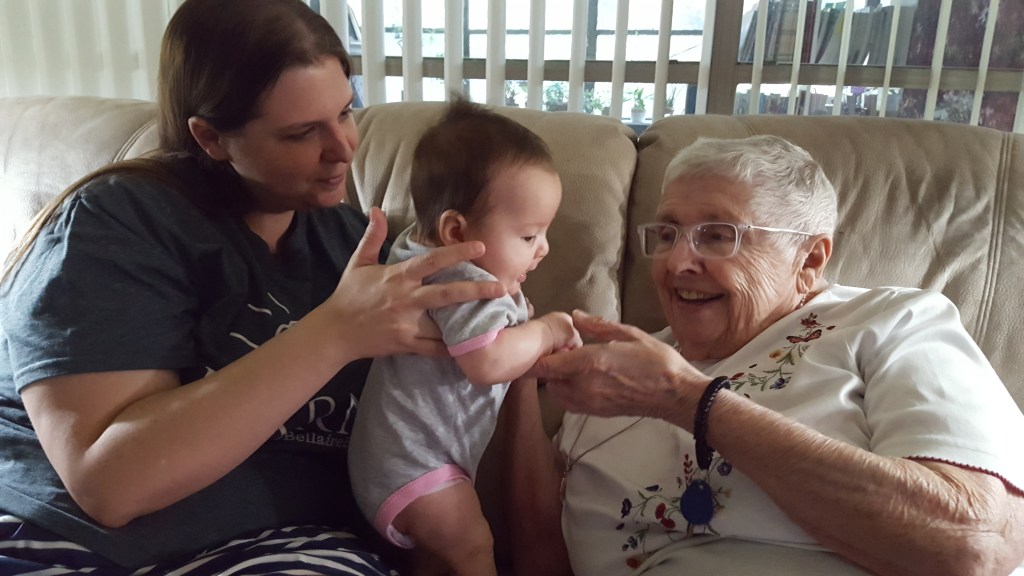
Suzanne getting to meet her great-grandmother, Lois, a former kindergarten teacher. If history is any indication, I expect that school will play just as big a role in Suzanne’s life as it has in the lives of her matrilineal ancestors.
Soap Box

Reclaiming My Time

In my third year of teaching, I needed to have some surgery, so I scheduled the procedure for the middle of October and planned to be out of my classroom for the three days I would need to recover.

Did I absolutely need to have it right then? another teacher asked me. Couldn’t I push it to the week of the Thanksgiving break? Leaving my students with a substitute for half a week, she said, was akin to malpractice unless it was truly life-threatening.

This past week marked my fifteenth year of teaching and my third week of pandemic-induced virtual instruction. And even though my family has been pretty cautious in terms of social distancing, I began to get worried when I developed a cough. A day later I had a sore throat, and then that same evening I found myself utterly exhausted and strangely chilled.

Yesterday morning, Saturday, I knew it was time for a COVID test. I held my head back as the nurse tickled my brain with a Q-tip and then waited in my car for the results. Fifteen minutes later, my phone rang, and they asked me to come back inside – the receptionist slide a piece of paper towards me from under the plexiglass. I was negative. I wasn’t incubating a lethal virus; it must have been the combination of allergies and stress and very long hours.

I felt relieved and worried at the same time. It was great that I didn’t have it – today – but what about our impending return to face-to-face instruction? If the demands of teaching can suppress my immune system and leave me feeling weak and drained, how is my body going to mount a defense against one of the worst respiratory viruses in history?

We have come to accept that an occupational hazard of teaching is the risk that it poses to our physical and mental health: in our shitty health insurance, in the stress of unreasonable workloads and performance targets, in the risk of death-by-mass-shooter that is becoming increasingly a feature of our workplace, in our sacrificial exposure to a lethal virus at the altar of the illusion of normalcy.

And these unreasonable expectations aren’t just coming from politicians, administration, and the community; we perpetuate them ourselves. We know that the system isn’t coming to save our kids, so we try to fill in the gaps – with our time, with our money, and with our hearts.

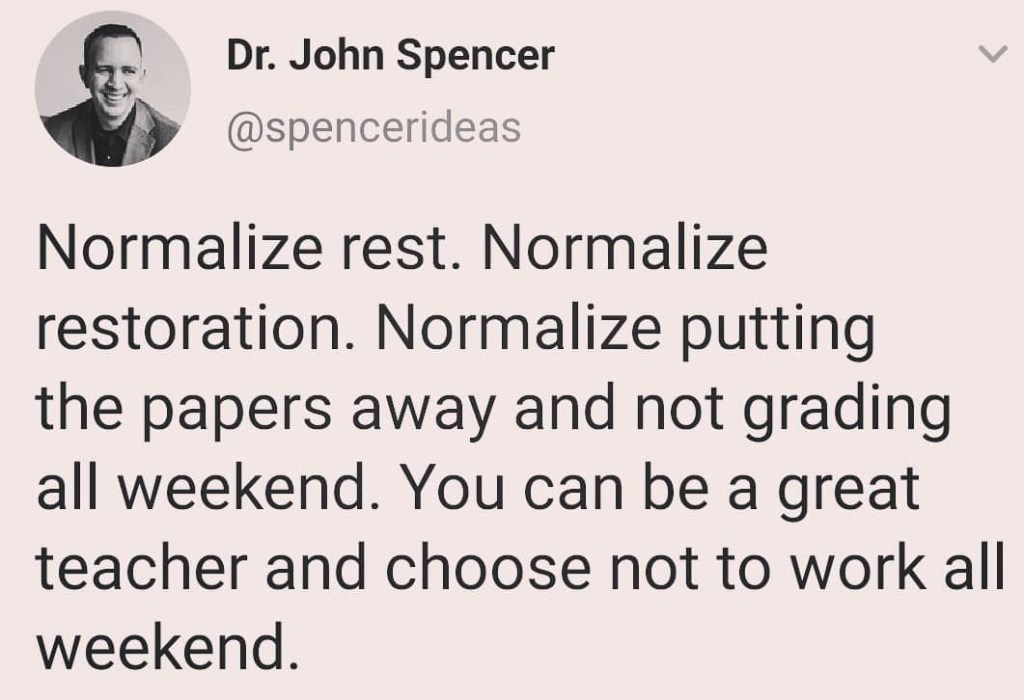
So I was thrilled to see trending over the last couple of weeks the argument that teachers need to prioritize self-care and establish some boundaries in terms of what we are willing to give to our work.

I’m opting into this. I need to be a healthy and whole person if I’m going to serve my students well over the long-term. I spent all of yesterday grading and planning lessons (after the COVID test), but this morning, I committed to not checking my email over the entire day. My baby and I went for a walk at the botanical gardens, then I made a lunch of spaghetti and meatballs from scratch which we enjoyed as a family. I read a book while she was napping and worked on a writing project while she and her baba watched Sunday afternoon football, and then we closed out the day with a picnic with my parents.

Tomorrow I’ll get back to the grind, and I’ll love it because teaching is what I do and who I am. So I’m not going to feel guilty about living in the hours beyond my job in a way that sustains my ability to do it.

Soap Box

STAAR Day

staarday2

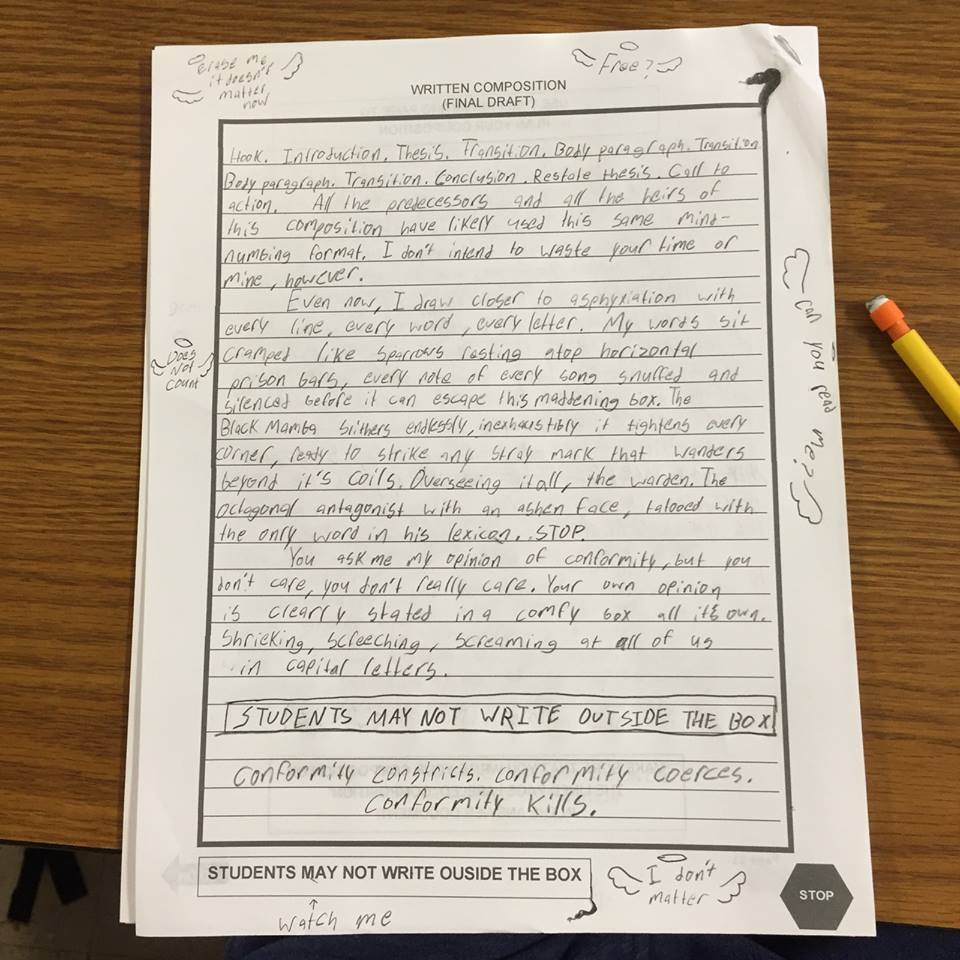
It was a bright cold day in April, and the students were inside testing. Last Tuesday kicked off STAAR Season 2018 with the administration of the English 1 and 2 exams. In a month or so, we will test in Biology, Algebra, and U. S. History. Students are required to pass all of these to receive their high school diplomas.

While my students were literally thinking inside the box (“the box” being the 7- by 10-inch rectangle that must contain their essay), I was in the library. I am on the Testing Team, which is like the Avengers, but instead of saving the world, we are complicit in its destruction.

staarday1

My specialty is seating charts. When teachers return from their five-hour sentence lugging a big box of forms and manuals and sundry other paper artifacts of the bureaucracy, they must give me their seating chart to scrutinize before they can pass onto the next stage of testing check-in. We have a form that we must use, with 30 neat little boxes, all in rows. What happens if the configuration of the room does not allow for a 5×6 grid-style layout? Well, you still have to put the students in the boxes, regardless of whether or not it bears any resemblance to the reality of the classroom.

“You have to write out the ENTIRE nine-digit booklet number on each of the 30 boxes,” I told the German teacher. “I know that it’s the SAME for the first seven digits, but you still have to do it.”

“I need the time that each of these students individually turned in their testing materials labelled on their boxes,” I said to a math teacher. “I KNOW that there’s not a spot for it, and I agree that there should be, but I don’t make the form. I don’t know WHY we have to do it, but we’ll get in trouble if we don’t. Just guess if you can’t remember.”

I tracked down a teacher who submitted a seating chart with a missing form number to ask her to account for the irregularity. She said that that student was the last to finish, and she was just so happy to be done with the test that she forgot to write it down. “Well, now I’M going to have to search through HUNDREDS of test books to find it,” I sniped.

This is not who I am – at least not on the 175-non-testing days in the instructional calendar. I swoon over novels. When I was in first grade, I got in trouble for not coloring inside the lines (literally). I have a bumper sticker that says “Teach Peace.”

But I am guilty of having been obedient. If I were a better, braver person, I would refuse to be a part of a system that I know is not only broken but bankrupt. I would set those boxes of tests on fire.

“How did the test go?” I asked my students the day after the exam.

“It went well,” said Ben. “Except I couldn’t think of any concrete examples for my essay.”

“What?!”

“Haha, just kidding.”

“Thank goodness.”

“I wrote a poem in German. And I composed it entirely in the margins, outside of the box.”

“…Okay,” I said, and I meant it.

Soap Box

Bullet Points

When the loudspeaker crackled on and announced that our school was having an active shooter drill and we were to go into lockdown, I whispered the word “fuck” from the shot of adrenaline to my heart in front of my class of 37 ninth-grade students. This was hilarious, at least if you are 15 years old.

My classroom doesn’t have windows, so when we turn out the lights, you can’t see a foot in front of your face. This is also very funny to my students. Who might be kissing in the dark? We had better all giggle about it.

Lockdown procedure calls for absolute silence, a protocol that my students took as a mild suggestion. I hissed at them to turn off their phones and close their mouths.

So we sat in the dark and the silence imagining what if a mass murderer with the means to kills hundreds of people in a matter of minutes were loose in our school. Where would the bullets hit us? In the leg, in the face, in the gut? What does a pool of real blood look like? Is it the same as in the movies? Who would get lucky? Who would sacrifice themselves? Whose parents were in for the worst phone call of their lives?

A sharp bang and a rattle burst from my classroom door and caught my heart and hooked it up into my throat: some anonymous administrator, checking to make sure that the lock was secure. I thought about how the door would make that same sound if the person on the other side of it had a gun. None of my students laughed at this.

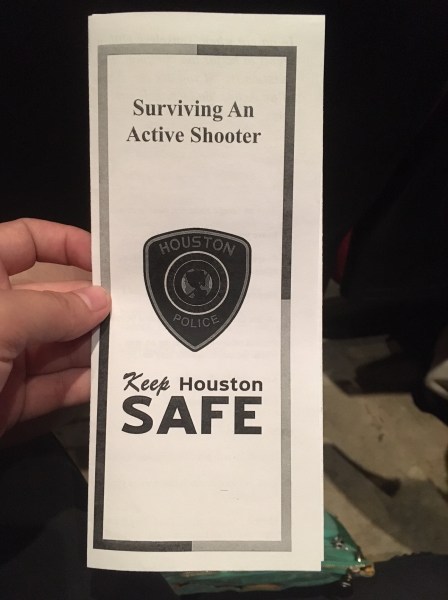
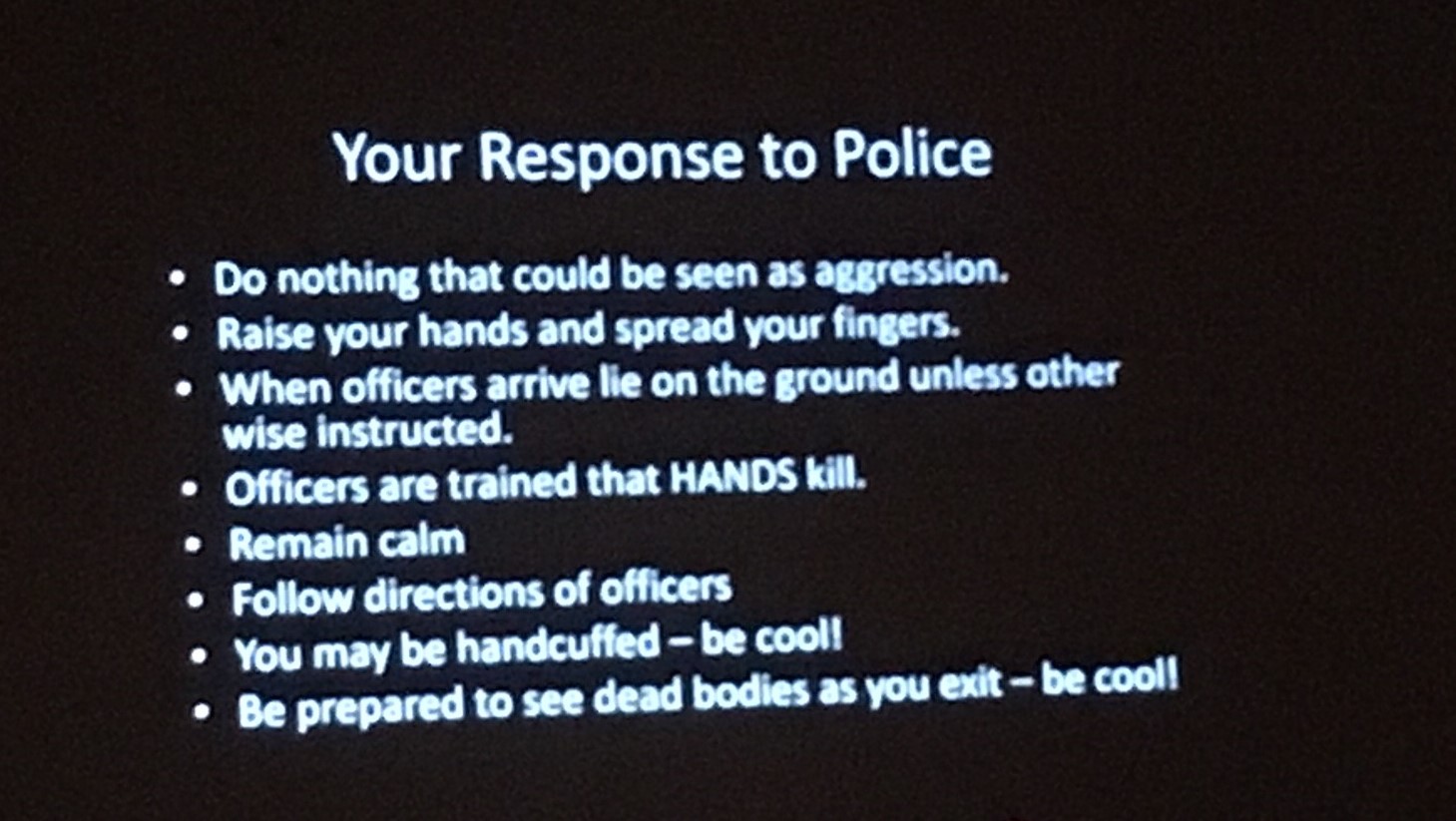
Later that afternoon, our faculty had “Surviving an Active Shooter” training in the auditorium. A Houston Police Department specialist in mass shootings delivered some bullet-point tips on what we could do to protect ourselves and our students:

bulletpoints1

  • Consider what everyday classroom items could be used as deadly weapons to defend against your attacker. That red pen you use to grade student essays is capable of paralyzing a man if applied to the spinal column. The scissors you had on your desk for cutting off the bottom halves of permission slips should be stabbed into the attacker’s shooting arm.
  • After you have taken down the attacker through grievous bodily injury, take the plastic bag from your trashcan and wrap it around his head to cut off oxygen and minimize the chances of him getting back up.
  • Be prepared to practice first-aid until emergency services arrive. A computer cord can be used as a makeshift tourniquet. A thin piece of plastic – say, a candy wrapper – could be used to slow the blood loss from a child’s sucking chest wound.
  • Try to do all of this without the use of your hands. Police officers are trained to see hands as a threat, so make sure that yours are empty and held up so that you are not mistaken for the active shooter.
  • “You may be handcuffed – be cool!”
  • “Be prepared to see dead bodies as you exit – be cool!”

bulletpoints2

Implicit in all of this advice and in the lockdown drill was the assumption that our protocol for protecting our children from lunatics with guns kicks in after they have stepped foot on campus. Teachers – not gun owners, not the firearms industry, not legislators – are being asked to shoulder the burden of reckoning with the perfect storm caused by white, male entitlement and massacre-grade weaponry.

I think that the sound of the door handle rattling as we imagined our deaths will stay with me for the rest of my life. I keep wondering, if there were really a shooter, would the door hold? There ought to be a lot more than a flimsy piece of plywood standing between a killer and our kids.